


Kenya Ministry of Health resource · Second edition, 2016
Understanding Epilepsy. Knowing How to Help.
Understand seizures, learn practical first aid, and explore guidance to support people living with epilepsy at home, at school, and in the community.
This page summarises the Kenya National Guidelines for the Management of Epilepsy: A Practical Guide for Healthcare Workers, second edition, 2016, published by Kenya’s Ministry of Health. NeuroReHub did not publish the guidelines.
SEIZURE FIRST AID
Someone Is Having a Seizure. How Can You Help?
Most seizures stop on their own. These steps keep the person safe.
1
Stay calm and time it
Stay calm, remain nearby, and time the seizure.
2
Make the area safe
Clear surrounding hazards. Cushion the head if the person is on the ground and loosen tight clothing around the neck.
3
Move them only if needed
Move the person only if their location is dangerous.
4
Recovery position
After convulsions stop, gently place them on their side and stay until they recover.
5
Do not restrain or feed
Do not restrain their movements or put anything in their mouth.
6
Food and drink later
Wait until they are fully alert before offering food or drink.
Get emergency help
Call local emergency services if:
- the seizure lasts more than five minutes
- seizures keep happening and the person does not recover between them
- the person has difficulty breathing afterwards
- the person is seriously injured
- the seizure happens in water
- it is the person’s first seizure
- the seizure happens during pregnancy
If a person has a prescribed emergency care plan, rescue medication should be given only by someone trained to follow that plan.
Source of this section: general first-aid advice from CDC: First aid for seizures and NHS: What to do if someone has a seizure, not from the 2016 guidelines. Emergency numbers differ by country, so use local emergency services.
UNDERSTANDING EPILEPSY
Seizures Can Look Different
Seizures can affect movement, awareness, behaviour or sensations. Some involve shaking. Others are brief and easy to miss.
Movement
Some seizures involve shaking or stiffening. Others may involve brief jerks or sudden loss of muscle control.
Awareness
A person may seem to stare, stop responding or not remember the episode afterwards.
Behaviour
A person may repeat movements, appear confused or act in an unusual way for a short time.
Sensations
Some people notice unusual feelings, smells, tastes or sights before or during a seizure.
Good to know. Epilepsy is a neurological condition. It is not contagious, and it is not caused by curses or witchcraft; the guidelines state this directly. A single seizure does not automatically mean a person has epilepsy. Diagnosis needs assessment by a healthcare professional. Treatment can help many people, but no outcome is guaranteed. WHO epilepsy fact sheet
Causes and triggers are different
A cause is the underlying reason
The guidelines describe many possible causes and risk factors, which can differ by age. They include head injuries, infections, birth-related problems and genetic factors. Sometimes no cause is found.
A trigger can make a seizure more likely
For some people, certain situations make a seizure more likely. The guidelines list examples such as missed medicine, lack of sleep, infections or illness, and stress. Triggers vary from person to person. Flashing lights affect only some people with epilepsy, and not everyone has any known trigger.
This page does not diagnose. The 2016 edition uses older seizure terminology, so it should not be read as the latest classification.
PREPARING FOR CARE
Make the Next Healthcare Conversation Easier
A few notes beforehand can help the clinician understand what happened.
What to note down
- What happened before, during and after the episode
- When it started and how long it lasted
- Any changes in awareness or movement
- How the person recovered afterwards
- Current medicines, any missed doses, and questions for the clinician
An eyewitness account is very helpful, because the person may not remember the seizure. Keep these notes for yourself; this website does not collect them.
At the appointment
The guidelines describe taking a careful history. A healthcare professional may recommend tests based on the person’s situation. Not everyone needs every test, and a normal EEG does not by itself rule out epilepsy.
A routine care pathway
1
Notice and record
Note what happened and when.
2
Seek assessment
See a healthcare professional.
3
Agree a care plan
Decide treatment and support together.
4
Continue follow-up
Attend reviews and share changes.
This is the routine pathway. For emergencies, use the “Get emergency help” guidance above.
ONGOING SUPPORT
Care That Supports Everyday Life
Good care combines treatment with understanding, routine and safety.
Follow the plan
Follow the agreed treatment plan and attend reviews.
Talk about side effects
Discuss side effects or continuing seizures with the healthcare team.
Routines and triggers
Identify individual triggers and support regular routines, including sleep.
Share the care plan
Help family members and teachers understand the person’s care plan.
Plan for safety
Plan safety around activities such as swimming, cooking and working at heights.
Wellbeing and participation
Support emotional wellbeing and taking part in daily life.
Medicines. Always seek professional advice before changing or stopping epilepsy medicine. Stopping suddenly can bring seizures back.
Family planning. People taking epilepsy medicines should discuss pregnancy plans promptly with their specialist, and should not stop treatment on their own if pregnancy occurs. WHO has issued specific safety guidance on valproate for women and girls who could become pregnant: WHO guidance, 2023
The 2016 guidelines contain drug-choice tables, doses and treatment protocols for healthcare workers. They are not reproduced here and should not be used as current prescribing advice.
SCHOOL, FAMILY AND COMMUNITY
Understanding Creates Greater Possibilities
Support at home, in class and in the community helps people take part fully.
At school
Help teachers recognise seizures and understand the agreed first aid.
Learning and friendships
Support learning, friendships and taking part in activities.
Individual needs
Plan activities around each person’s needs, not assumptions.
Accurate information
Challenge stigma with accurate information. Epilepsy is not contagious.
Dignity and privacy
Respect dignity, privacy and the person’s involvement in decisions about their care.
Across the lifespan. The 2016 guidelines cover children, adolescents, older adults and pregnancy, and each stage can bring different considerations. Epilepsy can sit alongside other health, developmental or learning needs, so support should be individual. It does not automatically mean intellectual disability or autism, and it does not automatically mean a person cannot go to school or work. For questions about driving, speak to the person’s clinician and the relevant licensing authority.
FURTHER SUPPORT
Finding the Right Support
A local healthcare facility can help with assessment and ongoing care, and can refer you to specialist input when needed.
The 2016 guidelines describe epilepsy care at community, primary-care and referral levels, with referral on when more specialist care is needed. Teachers and communities also help by recognising seizures and encouraging people to seek care.
Epilepsy & Seizure Disorders
An overview page on this website about epilepsy and seizures.
Therapy Hospitals Kenya
A healthcare and therapy directory listed on this website.
Contacts Resource Centre
A special needs support directory on this website.
NeuroReHub is an information website. It is not an emergency or medical service, and it does not arrange appointments or referrals. In an emergency, contact local emergency services.
INSIDE THE GUIDELINES
What the full document covers
Eight chapters for healthcare workers. Open a chapter for a short description.
Chapter 1: Introduction
Understanding epilepsy and its presentation.
Starts on printed page 15 (PDF page 16).
Chapter 2: Causes and risk factors
Underlying causes and possible seizure triggers.
Starts on printed page 19 (PDF page 20).
Chapter 3: Classification of seizures
Seizure patterns described in the 2016 edition.
Starts on printed page 23 (PDF page 24).
Chapter 4: Diagnosis and investigations
Clinical assessment, history and investigations.
Starts on printed page 32 (PDF page 33).
Chapter 5: Management
Treatment, first aid, emergencies and follow-up.
Starts on printed page 45 (PDF page 46).
Chapter 6: Coexisting conditions
Additional needs that may influence care.
Starts on printed page 64 (PDF page 65).
Chapter 7: Epilepsy in special groups
Considerations across life stages.
Starts on printed page 66 (PDF page 67).
Chapter 8: Social aspects
Stigma, participation, employment and rights.
Starts on printed page 73 (PDF page 74).
The appendices cover the organisation of epilepsy services and medicine information for healthcare workers.
THE FULL DOCUMENT
Read the original guidelines
The complete professional reference, unchanged.
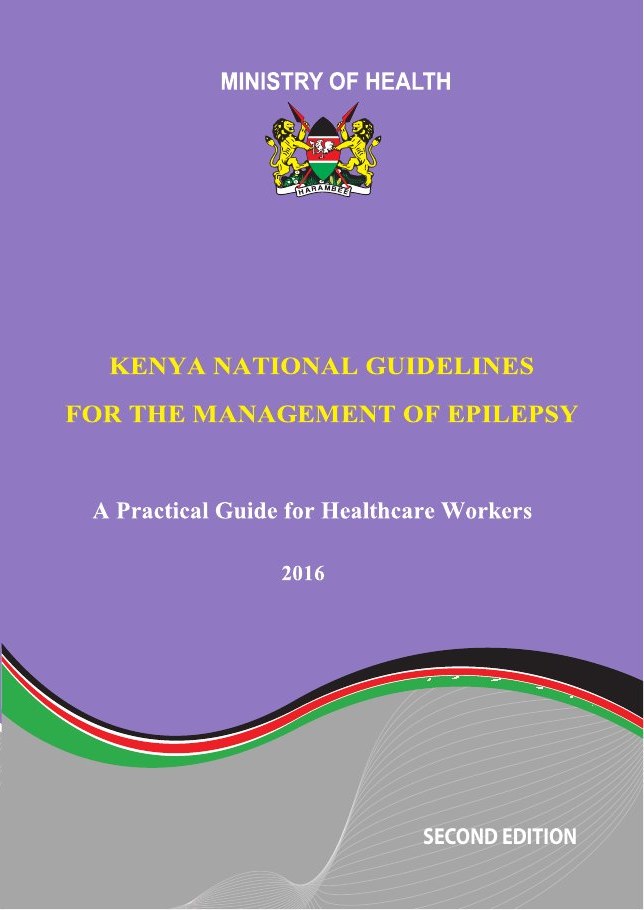
Front cover of the 2016 second edition
Kenya National Guidelines for the Management of Epilepsy
A Practical Guide for Healthcare Workers
Ministry of Health, Kenya · Second edition · 2016 · PDF
This is the 2016 professional reference. Clinical decisions should follow current professional guidance.
Supplementary official sources
Separate from the Ministry document:
- CDC: First aid for seizures
- NHS: What to do if someone has a seizure
- WHO: Epilepsy fact sheet
- WHO: Valproic acid in women and girls of childbearing potential
The Ministry, WHO, CDC and NHS do not endorse NeuroReHub.