


Kenya Ministry of Health · Strategy 2022–2026
Rehabilitation and Assistive Technology: Supporting Everyday Life
Explore Kenya’s 2022–2026 strategy for improving access to rehabilitation and assistive technology—and how these services can support communication, mobility, learning and participation.
Source: Rehabilitative Services and Assistive Technology Strategy 2022–2026, Ministry of Health, Republic of Kenya. This page summarises the strategy. It does not describe services as they are today, and NeuroReHub is not the Ministry of Health.
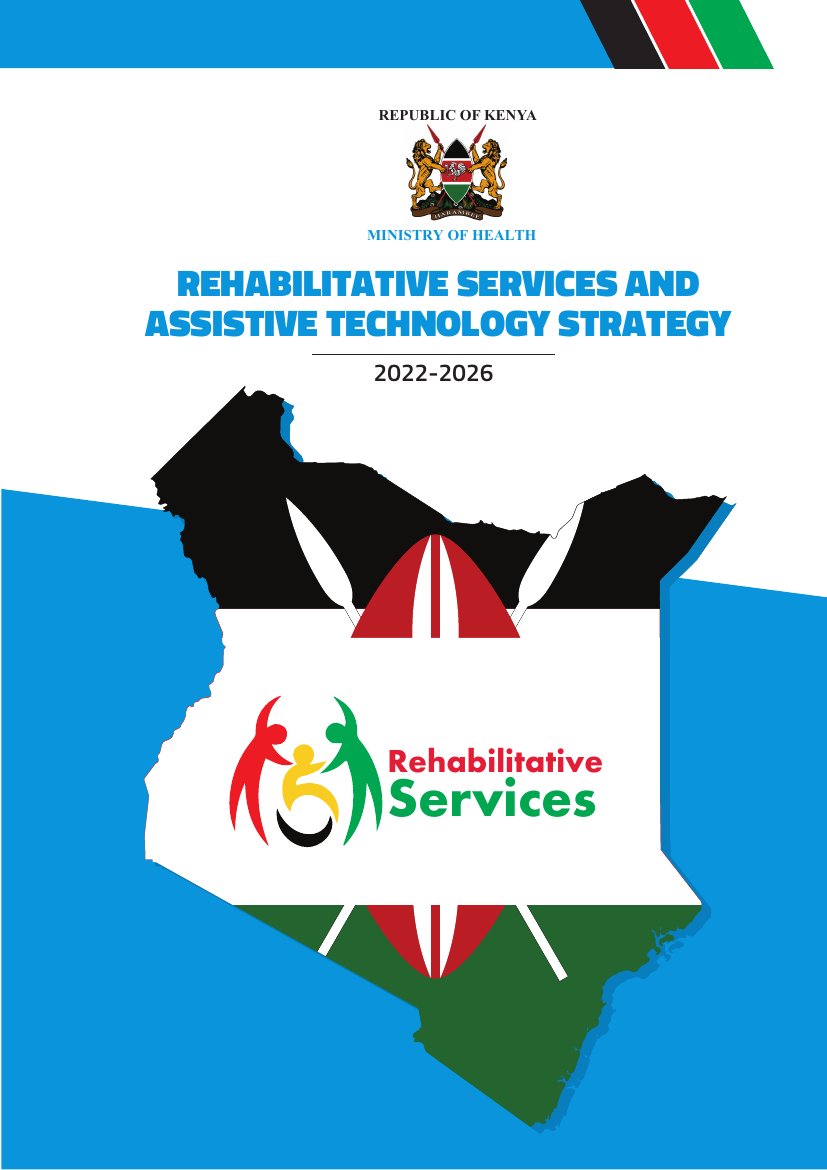
Cover of the strategy document (PDF)
2022–2026
strategy period
Six
strategic directions
National and county
focus
EVERYDAY LIFE
Support That Makes Everyday Activities More Accessible
Rehabilitation and assistive technology help people do what matters to them.
Rehabilitation
The strategy defines rehabilitation as a set of interventions that optimise functioning and reduce disability for people with health conditions. It supports taking part in everyday activities such as moving around, communicating, caring for oneself, learning, working and community life.
Assistive technology
An umbrella term for the products and the services needed to provide and use them well. It goes beyond digital tools or apps. The document mentions examples such as wheelchairs, walking aids, hearing aids, white canes, prostheses and communication boards.
Support is individual. Not everyone needs the same service or device. The strategy stresses each person’s needs and strengths, and teamwork among different professionals. Support that suits the person helps them take part in life on their own terms.
THE RANGE OF NEEDS
Different Needs. Connected Support.
The strategy covers several areas, and support can matter at different ages and in different circumstances.
Movement and daily activities
Physical rehabilitation, mobility, self-care and related assistive products.
Seeing, hearing and communicating
Vision support, hearing services, speech and language services and communication tools.
Developmental, cognitive and mental health support
The strategy covers three separate areas: autism, intellectual disability and mental health conditions. They are different. Autism and intellectual disability are not mental illnesses.
The focus is dignity, participation and each person’s own goals.
THE STRATEGY’S PRIORITIES
Six Priorities for Better Access and Support
The strategy sets six strategic directions. These are proposals for 2022 to 2026, not services that are in place everywhere.
1
Improve access
The strategy proposes expanding community-based rehabilitation, stronger referrals, accessible facilities, awareness campaigns and caregiver support.
In practice: Services would be closer to people and easier to reach.
2
Strengthen policies and guidance
It proposes clearer standards, better coordination and policies that support consistent service provision.
In practice: Similar standards of care across places.
3
Improve service delivery
It proposes more trained professionals, better equipment, suitable facilities and teamwork across disciplines.
In practice: Rehabilitation as a connected part of health care.
4
Expand access to assistive technology
It proposes appropriate products, trained providers, quality standards, local production and coordinated supply.
In practice: The right device, with the support to use it.
5
Improve financing
It proposes more sustainable funding and ways to reduce financial barriers for users.
In practice: Costs would be less of a barrier.
6
Strengthen leadership and accountability
It proposes better representation, coordination, planning and responsibility at national and county levels.
In practice: Clear ownership of rehabilitation services.
The “in practice” lines are plain-language summaries of what each priority aims for. Source: Chapter 3, Strategic Direction (PDF pages 35 to 39).
CHALLENGES AND RESPONSES
What Needs to Change?
The left column lists challenges the strategy describes. The right column shows what it proposes in response.
| Challenge described in the strategy | Proposed response |
|---|---|
| Long journeys and limited local access | Stronger community and primary-care services. |
| Fragmented care | Better referrals and collaboration between professionals. |
| Limited awareness and stigma | Accessible information and community engagement. |
| High costs | Stronger financing arrangements. |
| Limited access to suitable devices | Improved supply, quality standards and trained providers. |
The challenges are findings described in the strategy, which draws on a 2019 survey of counties. They are not a new assessment of conditions today.
ASSISTIVE TECHNOLOGY
The Right Support Involves More Than a Product
The strategy treats assistive technology as a complete service.
1
Understand needs
Assessment of what the person needs.
2
Appropriate products
Suitable products, fitted or adjusted where relevant.
3
Trained provision
Trained providers who explain how to use the product.
4
Continued support
Follow-up and ongoing support.
Proposed supply improvements
- Better information about demand for assistive devices
- Coordinated purchasing and distribution
- County and facility involvement, including sub-county storage hubs
- Product quality checks and appropriate handling
- Support for local production and innovation
The proposed role of KEMSA
In the strategy’s proposed supply model, the Kenya Medical Supplies Authority (KEMSA) would order assistive devices in bulk from pre-qualified suppliers and deliver them to regional depots. Counties would then collect and distribute them to facilities. This is a proposal, not a description of how supply works today.
This page has no ordering form, device quiz or eligibility checker, and it does not promise free equipment.
PROPOSED SERVICE ORGANISATION
Bringing Support Closer to Communities
This is how the strategy proposes to organise rehabilitation services. The top of the stack shows the most specialised care.
L5–6
Levels 5 and 6
More specialised care, training, mentorship and research.
L4
Level 4 facilities
Broader rehabilitation services and coordination with primary care.
L2–3
Primary care — Levels 2 and 3
Basic rehabilitation and outreach services.
L1
Community — Level 1
Awareness, community-based rehabilitation and referral links.
The strategy seeks stronger connections between community services, facilities and specialist teams, with rehabilitation staff working together in one department in each facility.
This is a proposed model, not a claim that every facility already offers all of these services.
IMPLEMENTATION
Making the Strategy Work
Responsibility is shared across levels of government and with partners and communities.
National Ministry of Health
Policy, standards, coordination, capacity building and technical support.
County governments
Service delivery, staffing, facilities, local planning and implementation.
Training institutions, partners and manufacturers
Skills development, research, innovation and support for implementation.
Communities and service users
Participation, awareness and involvement in decisions that affect their support.
How progress is intended to be measured
The strategy’s monitoring framework covers accessibility, the rehabilitation workforce, service availability, assistive technology provision, financing and reporting.
Its implementation matrix sets planned annual targets, not verified results. The detailed activities and indicators are in the full PDF (PDF pages 54 to 71).
THE FULL DOCUMENT
Explore the Full Strategy
Read the complete strategy, including the implementation matrix and indicator tables.
Cover of the strategy
Rehabilitative Services and Assistive Technology Strategy 2022–2026
- Publisher: Ministry of Health, Republic of Kenya
- Format: PDF
- Length: 80 pages
What the document contains
- Background and situation analysis (from PDF page 12)
- Strategic direction (PDF page 35)
- Proposed service arrangements (PDF page 40)
- Implementation plan (PDF page 53)
- Monitoring and evaluation (PDF page 64)
- References and annexes (PDF page 72)
PDF page numbers. The contents list in the PDF uses different page numbers from the actual pages.
The document is published by the Ministry of Health, Republic of Kenya. NeuroReHub is not the Ministry of Health and has no official endorsement. Financing and legislative references stay in the context of the strategy. They are not advice about eligibility or insurance cover.
NEXT STEPS
Understand the Options. Explore Further Support.
Explore related resources to learn more about rehabilitation, assistive technology and support for everyday participation.
Occupational Therapy
Learn about occupational therapy on this website.
Physio Therapy
Learn about physiotherapy on this website.
Therapy Hospitals Kenya
A healthcare and therapy directory listed on this website.
Community Based Inclusive Development Training Manual
Practical learning on inclusion and everyday participation.