
Cerebral Palsy (CP)
Cerebral Palsy (CP) is the most common motor disability in childhood, characterized by a group of non-progressive neurological disorders that permanently affect a person’s ability to move, maintain balance, and sustain posture. It is caused by abnormal development or damage to the developing brain before, during, or shortly after birth. Our resources focus on personalized therapy, assistive technology, and maximizing independence across the lifespan.
I
OVERVIEW
Understanding Cerebral Palsy
CP is a diverse condition. The word “Cerebral” means relating to the brain, and “Palsy” means weakness or problems with using the muscles.
A Non-Progressive Condition: The brain injury that causes CP is non-progressive (it does not worsen over time), but its effects on the body—like muscle stiffness and joint issues—may change and evolve as a person grows.
Causes: The cause is damage or abnormal development of the brain’s motor control centers, often stemming from events such as premature birth, lack of oxygen, infections, or stroke in the developing brain.
Associated Conditions: While CP primarily affects movement, many individuals also experience co-occurring conditions, including intellectual and developmental disabilities (IDDs), epilepsy, vision or hearing impairments, speech difficulties, and pain.
Lifelong Support: CP symptoms range from very mild (a slight awkwardness in gait) to severe (requiring full-time care and support), emphasizing the need for highly individualized and lifelong interventions.
I
CLASSIFICATION
Types and Classification
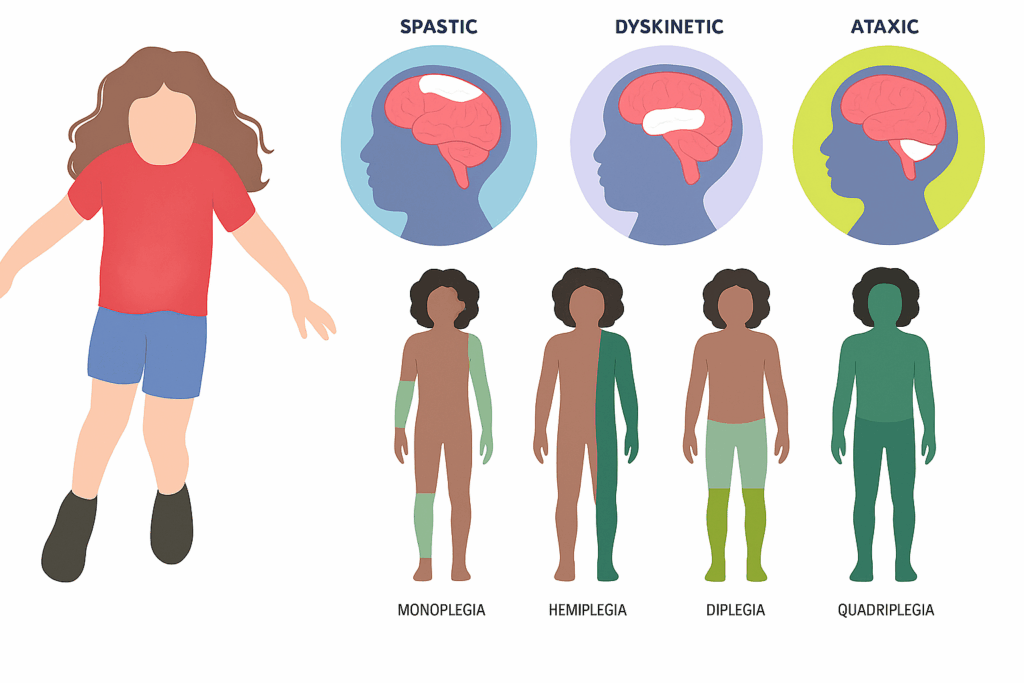
CP is classified primarily by the type of movement disorder and the body parts affected (topography).
1. Classification by Movement (Motor Type)
Type
Description
Affected Area
Spastic CP (Most Common: 80%)
Causes increased muscle tone (hypertonia), leading to stiff, tight muscles and awkward, jerky movements.
Motor Cortex/Pyramidal Tracts
Dyskinetic CP (Athetoid)
Involves uncontrollable, slow, writhing (athetosis) or rapid, jerky (chorea) movements of the hands, arms, feet, and legs. Muscle tone fluctuates throughout the day.
Basal Ganglia
Ataxic CP
Affects balance and coordination. People may have shaky movements, difficulty with precise motor control (like writing), and walk unsteadily.
Cerebellum
Mixed CP
Occurs when symptoms do not fit a single category and present as a combination of two or more types, most commonly Spastic-Dyskinetic.
Multiple areas
2. Classification by Body Area (Topography)
These terms describe which parts of the body are most affected by the motor type:
Diplegia: Affects both legs significantly more than the arms.
Hemiplegia: Affects the arm and leg on one side of the body.
Quadriplegia: Affects all four limbs, the trunk, and the face, and is typically the most severe form.
I
SUPPORT
Evidence-Based Support Strategies
Effective management of CP is ongoing and relies on a collaborative team approach focused on maximizing function, mobility, and communication.
Physical Therapy (PT): Essential for maintaining or improving muscle strength, flexibility, mobility, posture, and gait. PT helps prevent contractures (muscle shortening) and can involve stretching, strengthening exercises, and gait training.
Occupational Therapy (OT): Focuses on developing fine motor skills and adapting environments to increase independence in Activities of Daily Living (ADLs), such as dressing, feeding, writing, and school activities.
Speech-Language Pathology (SLP): Addresses communication difficulties, which may include speech production, language comprehension, and issues with sucking, chewing, and swallowing (feeding therapy).
Assistive Technology (AT) & Devices: Key to independence. This includes orthotics (braces), mobility aids (walkers, wheelchairs), and Augmentative and Alternative Communication (AAC) devices to support non-verbal communication.
Medication & Surgery: Medications (like muscle relaxants or Botox injections) can help manage spasticity and reduce pain. Surgical interventions may be used to correct bone and joint deformities or lengthen tight muscles.
Your Action Plan & Resources
The goal of this Hub is to connect you with the right tools and professionals to help your loved one achieve their full potential.
Finding Professional Support
Use our specialized directory to connect with practitioners: