


Resource · Ministry of Labour and Social Protection
Community Based Inclusive Development (CBID)
Building communities where everyone can participate
Explore practical approaches to health, education, livelihoods, social inclusion and empowerment for persons with disabilities, their families and communities in Kenya.
Based on the CBID Awareness Booklet of the Ministry of Labour and Social Protection and the State Department for Social Protection and Senior Citizen Affairs. This page is an explanatory summary; the booklet is the source document.
THE FIVE CBID COMPONENTS
Health
Education
Livelihood
Social
Empowerment
Programmes are shaped by local needs, priorities and resources.
WHAT IS CBID?
Community Based Inclusive Development
A way of working so that persons with disabilities can take part in community life on an equal basis.
Active participants
Persons with disabilities are participants, contributors and decision-makers in community life, not only recipients of services.
A rehabilitation strategy and a community development model
The booklet describes CBID as a systematic approach that helps persons with disabilities live fulfilling lives within their communities, using local resources and promoting equal participation.
FIVE THEMES RUNNING THROUGH THE BOOKLET
Removing barriers
Physical, communication, social and attitudinal barriers that limit participation.
Accessible services and opportunities
Services and opportunities that persons with disabilities can reach and use.
Rights and dignity
Respect for rights and for the dignity of every person.
Independence and informed choice
Being able to make informed choices and decisions about one’s own life.
Working together with community resources
Persons with disabilities, families, organisations, communities, government and partners.
Who this booklet is for
The booklet lists these intended users:
- The public and communities
- Persons with disabilities and their families
- Organisations of persons with disabilities (OPDs)
- Social development officers and social development resource persons
- National government administration officers
- Ministries, departments and agencies (MDAs)
- Non-governmental organisations and development agencies
Source: PDF page 12
From CBR to CBID
- 1978. The World Health Organization (WHO) initiated community-based rehabilitation (CBR) following the Declaration of Alma-Ata.
- 2010. WHO CBR guidelines were developed.
- Since then. CBR has evolved into a multi-sectoral, inclusive, rights-based approach, which the booklet calls CBID.
Source: PDF page 11
What CBID aims to do
As described in the booklet, CBID aims to:
- maximise physical and mental ability
- ensure access to services and opportunities
- protect rights by removing barriers to participation
- bring persons with and without disabilities together
- help reduce poverty
Source: PDF page 11 and PDF page 22
Figures quoted in the booklet, with their sources. The booklet cites the Global Report on Health Equity for Persons with Disabilities (2022), which estimates that 16% of the world’s population are persons with disabilities. It also cites a World Bank/WHO report from 2011, which says persons with disabilities are 20% of the world’s poorest people and that 80% live in developing countries. These are quoted as reported in the booklet, not as current counters.
PRINCIPLES
The values and approaches behind CBID
Six principles guide the work, and four approaches put them into practice.
SIX PRINCIPLES
Dignity, autonomy and independence
Respect for inherent dignity, individual autonomy including the freedom to make one’s own choices, and independence of persons.
Non-discrimination
No one is treated unfairly because of disability.
Respect for difference
Acceptance of persons with disabilities as part of human diversity.
Equality of opportunity
Equal chances to take part in all areas of life.
Equality between women and men
Women and men, girls and boys have equal opportunities.
Children’s evolving capacities and identities
Respect for the developing capacities of children with disabilities and their right to preserve their identities.
FOUR APPROACHES
1
Awareness
Understanding disability and what it means for participation, and challenging stigma.
2
Participation
Involving persons with disabilities in designing, delivering and reviewing programmes.
3
Accessibility
Addressing physical, communication, policy and attitudinal barriers.
4
Twin-track
Combining mainstream inclusion with disability-specific support.
THE TWIN-TRACK APPROACH
Track one: inclusive mainstream services
Schools, clinics, workplaces, training centres and community programmes are made welcoming and accessible to everyone.
⇄
work together
Track two: disability-specific support
Targeted measures, such as assistive devices, therapy, communication support or personal assistance, for people who need them to take part.
A rights-based approach. The booklet frames CBID within a human-rights model and social-model thinking: participation is limited by barriers in the environment and in attitudes, not by the person. Awareness, participation, comprehensive accessibility and the twin-track approach are its core principles (PDF page 12).
THE CBID MODEL
Five components, twenty-five elements
The WHO matrix groups CBID work into health, education, livelihood, social and empowerment. Select a component to jump to its section.
Health
- Promotion
- Prevention
- Medical care
- Rehabilitation
- Assistive devices
Read the Health section →
Education
- Early childhood
- Primary
- Secondary and higher
- Non-formal
- Lifelong learning
Read the Education section →
Livelihood
- Skills development
- Self-employment
- Wage employment
- Financial services
- Social protection
Read the Livelihood section →
Social
- Personal assistance
- Relationships, marriage and family
- Culture and arts
- Recreation, leisure and sports
- Justice
Read the Social section →
Empowerment
- Advocacy and communication
- Community mobilisation
- Political participation
- Self-help groups
- Organisations of persons with disabilities
Read the Empowerment section →
How to read this overview. The matrix is a shared framework. Programmes are shaped by local needs, priorities and resources, and are not expected to deliver every element. Partnerships and alliances help persons with disabilities and their families benefit across all five components. Source: WHO CBR matrix as described in the booklet (WHO, 2020), PDF page 22.
HEALTH
Accessible care and everyday wellbeing
Health is a right that applies equally to persons with disabilities. CBID aims to support people through inclusive, affordable and participatory approaches at community level.
GOAL
Protect, respect and promote the health rights of persons with disabilities and their families; support participation in community health activities; and mainstream disability issues in health services.
Promotion
Empowering people and communities to adopt healthy behaviours, including inclusion in public health programmes, health workers trained in disability-inclusive practice (for example sign language and braille), accessible facilities and accessible communication such as Kenya Sign Language and braille.
Prevention
Reducing the occurrence or impact of health conditions at three levels:
- Primary: avoiding problems before they occur, for example immunisation, good nutrition and safe environments.
- Secondary: early detection and treatment, for example screening and checks.
- Tertiary: limiting the impact of established conditions through rehabilitation.
Medical care
Early identification, treatment and management of health conditions at different levels: primary care (clinics and dispensaries), secondary care (hospitals, often by referral), tertiary care (highly specialised referral hospitals), emergency care and long-term palliative or rehabilitative care.
Rehabilitation and habilitation, in plain language
Both are sets of measures that help a person reach and keep the best possible functioning in their everyday environment.
- Rehabilitation helps someone regain skills or independence they have lost, for example after illness or injury.
- Habilitation supports children and others to develop skills they have not yet had the chance to develop, for example because of a disability present from birth or early life.
Both aim to support participation in family, community and economic life.
Assistive devices
Products, equipment and technology that support independence and participation, such as mobility devices, artificial limbs and splints, visual aids, hearing devices and screen readers. For devices to work well, the booklet says training, repair and changes to the environment need to come with them.
What health workers can contribute
The booklet describes health workers as central to CBID. Their contributions include:
- community education and awareness
- therapy and rehabilitation
- guidance and empowerment
- help planning and running CBID health programmes
- working with education, social services and other sectors
- early identification and referral
- access, training and support for assistive technology
Accessible information and communication
Persons with disabilities often face barriers such as cost, distance, transport and limited health information. Accessible communication formats, including Kenya Sign Language and braille, and trained health workers help people understand and use health services.
This section is general information about the booklet. It is not medical advice and does not diagnose, treat or recommend treatment. Please speak to a qualified health worker.
EDUCATION
Learning and participation throughout life
Inclusive education aims to include children and adults with disabilities in the same learning settings as others, and to remove barriers to learning.
GOAL
Persons with disabilities access education and lifelong learning, leading to fulfilment of potential, dignity, self-worth and effective participation in society.
THE LEARNING JOURNEY
1
Early childhood
Birth to eight years. Children with and without disabilities play and learn together, with support for the best possible start.
2
Primary
Welcoming, inclusive local schools within the community, with attention to practical skills and continuous assessment.
3
Secondary and higher
Accessible schools and institutions, flexible curricula, career guidance and support for transitions.
4
Non-formal
Programmes that build knowledge and skills to improve quality of life and self-reliance.
5
Lifelong learning
Learning opportunities for youth and adults, such as adult literacy, distance learning and life skills.
ALTERNATIVE APPROACHES AND SUPPORTS
Home-based education
Teaching at home, with regular visits from a teacher. It can prepare a child to move into school, and can reach children with severe or multiple disabilities who would otherwise not attend school.
Resource rooms and assessment
Educational assessment resource centres help assess children and guide placement in suitable education services. A resource room is a separate classroom inside an inclusive school where learners receive occasional specialised instruction and support.
Accommodation and accessible materials
Reasonable accommodation means necessary and appropriate adjustments, where needed in a particular case, that do not impose a disproportionate or undue burden. It sits alongside, and is different from, meaningful participation in learning.
Outcomes the work aims for
These are goals described in the booklet, not guaranteed results.
- Local schools admit all children and learn from disability perspectives; they are accessible, with flexible curricula and teachers trained on disability.
- Persons with disabilities take part in education as role models, decision-makers and contributors.
- Homes and communities encourage and support learning.
- Health, education, social and other sectors collaborate.
Who works together
Families, teachers, community workers, CBID workers and services collaborate. For example, CBID workers may identify children with disabilities and refer them to ordinary schools, which the booklet calls a first step in inclusive education that needs the acceptance of teachers.
Support is not automatic. The booklet lists government grants, scholarships and other funding as something CBID work hopes to help families understand and access. Availability, eligibility and procedures depend on the provider.
LIVELIHOOD
Skills, work and economic participation
Helping persons with disabilities and their families gain a means of living, access social protection and contribute economically and socially.
GOAL
A person with a disability gains a source of livelihood, accesses social protection to live a dignified life, and contributes to the lives of their family and community.
Self-employment
Economic activity owned and run by individuals or groups, part-time or full-time, in the formal or informal economy. Examples in the booklet: small income-generating activities, small and medium enterprises, and self-help groups.
Wage employment
Paid work under contract with an employer. CBID work aims to reduce barriers and support equal access to decent work.
Financial services and literacy
Persons with disabilities need the same access to services as everyone else to start, grow and sustain livelihoods: savings and loans (Saccos, banks, microfinance, mobile platforms, chamas), grants and social funds, and financial literacy.
Social protection
Safety nets against poverty and income loss. The booklet names CT-OVC, OPCT, PWSD-CT and HSNP. Requirements and availability must be checked with the provider.
Types of skills described in the booklet
| Type of skill | Examples |
|---|---|
| Foundation skills | Literacy, numeracy, problem-solving, learning ability |
| Technical and vocational skills | Carpentry, tailoring, weaving, welding, shoemaking, ICT and others |
| Professional skills | Advanced training such as engineering, physiotherapy, medicine and computer technology |
| Business and entrepreneurial skills | Planning, financial management, marketing, risk assessment |
| Core life skills | Communication, teamwork, customer relations, self-confidence, decision-making |
Ways to build skills
Self-learning and family-based training; basic education and community apprenticeships; vocational rehabilitation centres; on-the-job training, internships or volunteering; college or university; online learning and digital skills.
Outcomes the work aims for
These are goals described in the booklet, not guaranteed results.
- Youth and adults with disabilities gain marketable skills and access decent work, by wage or self-employment.
- Women and girls have equal opportunities alongside men and boys.
- Mainstream training and small-enterprise programmes include persons with disabilities.
- Persons with disabilities earn income from activities they choose, and are recognised as productive members of their communities.
- Persons with disabilities take part in livelihood programmes without discrimination.
Focus on youth and adults. This component is about skills, work and economic participation. Children’s learning is covered in the Education section. This page does not describe loan or benefit applications and does not promise funding. Where the booklet mentions waivers, tax exemptions or registration fee waivers for groups, eligibility is set by the relevant authority and should be checked with it.
SOCIAL
Belonging, relationships and community life
Taking part in social life affects self-esteem, quality of life and social standing. CBID aims for meaningful social roles for persons with disabilities and their families.
GOAL
Persons with disabilities and their families can make their own decisions, meet their basic needs, and change their lives positively as well as improve their communities.
Social inclusion
Being accepted as an individual, having relationships with family and friends, and joining in recreation and community activities.
Social roles
Positions people hold in society, with their responsibilities and activities.
Personal assistance
Support from another person for everyday living. The person chooses who assists and how the assistance is given.
Relationships, marriage and family
Supporting people to form and keep meaningful relationships and family connections.
Culture, arts and faith
Taking part in cultural and artistic activities, and being included in worship and faith-based activities.
Recreation, leisure and sport
Activities for fun, fitness and social involvement, with equipment and facilities adapted where needed.
RIGHTS AND DUTIES
Rights holders
Persons with disabilities are rights holders. They have entitlements, such as health, education, livelihood opportunities, land, housing and political participation, as outlined in the Convention on the Rights of Persons with Disabilities (CRPD), and they also have responsibilities.
Duty bearers
When someone has a right, someone else has a duty to respect, protect and fulfil it. Duty bearers include the state and non-state actors such as non-governmental organisations, religious leaders and parents, at national and local levels.
Access to justice
CBID aims to raise awareness of rights and support people and families to access justice when they face discrimination or exclusion, through both formal mechanisms (such as courts) and informal ones (such as village elders or leaders).
Outcomes the work aims for
These are goals described in the booklet, not guaranteed results.
- Persons with disabilities are valued family and community members with a variety of social roles.
- Stigma and discrimination are reduced.
- Barriers to social roles and activities are identified and addressed.
- Local government authorities respond to needs and provide effective social support and services where required.
EMPOWERMENT
Voice, choice and participation
Empowerment begins when persons with disabilities and their communities recognise that they can change their situation, and begin to do so.
GOAL
Persons with disabilities make their own decisions and take responsibility for changing their lives and improving their communities.
THE EMPOWERMENT PROCESS
1
Awareness
Knowing rights and what is possible
2
Capacity-building
Skills and knowledge that build confidence
3
Participation
Contributing at many levels
4
Decision-making
Informed choices about one’s own life
5
Action for change
Acting on issues that matter
Self-advocacy and communication
Having a voice of one’s own: knowing rights and responsibilities, speaking up, and making choices and decisions about one’s life.
Community mobilisation and self-help groups
Persons with disabilities and family members come together, form groups and organisations, and work on common problems.
Political and public participation
Promoting participation in politics and public life is described as an important approach to empowerment.
Organisations of persons with disabilities (OPDs)
OPDs promote CBID, and their members take part in planning, carrying out and monitoring CBID programmes together with CBID practitioners.
Outcomes the work aims for
These are goals described in the booklet, not guaranteed results.
- Persons with disabilities are active participants and contributors in their families and communities.
- Information is more accessible and persons with disabilities can make informed choices and decisions.
- Barriers are reduced, and potential is recognised.
- Persons with disabilities and their families can access development benefits and services in their communities.
- CBID programmes and OPDs work together to plan, implement and monitor programmes.
IN PRACTICE
Putting inclusion into practice
Six practical actions that recur through the booklet.
1
Involve people from the start
Invite persons with disabilities and their families to help design, deliver and review the work.
2
Find the barriers
Identify physical, communication, social and attitudinal barriers that limit participation.
3
Recognise strengths
Highlight the skills, strengths and contributions of persons with disabilities.
4
Connect with the community
Link with community organisations, OPDs, CBR programmes and local services.
5
Improve access and support
Make facilities, information and services more accessible, and arrange the support people need.
6
Encourage participation and review
Support people to take part, then review what is working and adjust.
This is a practical summary drawn from the booklet, in an order chosen for this page. It is not an official or mandatory sequence.
RIGHTS AND POLICY
The rights and policy foundations of CBID
International, African regional and Kenyan frameworks the booklet links to CBID. Open each item for details.
INTERNATIONAL
International frameworks
UN Convention on the Rights of Persons with Disabilities (UNCRPD)
Adopted by the UN General Assembly on 13 December 2006 and in force from 3 May 2008. Kenya signed in 2007 and ratified in 2008. The booklet lists Articles most relevant to CBID: 8 (awareness-raising), 12 (equal recognition before the law), 13 (access to justice), 19 (living independently and being included in the community), 23 (respect for home and the family), 24 (education), 27 (work and employment), 28 (adequate standard of living and social protection), 29 (participation in political and public life) and 30 (participation in cultural life, recreation, leisure and sport). PDF page 16
Sustainable Development Goals (SDGs)
Adopted in September 2015 on the principle of “leave no one behind”. The booklet notes that all 17 goals are relevant, and that Goals 1, 4, 8, 10.2, 11 and 17 refer specifically to disability. PDF page 16
Earlier global milestones
The booklet traces the history through the Universal Declaration of Human Rights (1948), the 1975 UN Declaration on the Rights of Disabled Persons, the 1981 International Year for Disabled Persons, the UN Decade of Disabled Persons and World Programme of Action (1982), the 1983 ILO Vocational Rehabilitation and Employment (Disabled Persons) Convention, and the non-binding UN Standard Rules (December 1993). PDF page 15
AFRICAN REGIONAL
African regional frameworks
African Disability Protocol
The Protocol to the African Charter on Human and Peoples’ Rights on the Rights of Persons with Disabilities in Africa was adopted by the African Union on 29 January 2018. The booklet states that Kenya ratified it in February 2022. It complements the UNCRPD from an African perspective. Articles the booklet links to CBID: 5 (non-discrimination), 7 (equal recognition before the law), 13 (access to justice), 14 (living in a community), 16 (education), 17 (health), 18 (habilitation and rehabilitation), 19 (work), 22 (self-representation), 23 (freedom of expression and opinion) and 24 (information). PDF page 17
KENYA
Kenyan laws and policies
Constitution of Kenya (2010)
The booklet lists these Articles as relevant to disability inclusion: 7(3)(b) (Kenya Sign Language, braille and other accessible communication), 10 (national values, including non-discrimination), 11 (culture), 27 (equality and freedom from discrimination, including on grounds of disability), 41 (fair labour practices), 43 (economic and social rights, including health, housing, food, water, social security and education), 45 (family), 48 (access to justice), 53 (children) and 54 (persons with disabilities). Article 54 includes dignity and respect, access to educational institutions and facilities, reasonable access to places, public transport and information, use of sign language and braille, and access to materials and devices; it also refers to progressive implementation of the principle that at least five percent of members of elective and appointive bodies are persons with disabilities. PDF page 17 to 18
Laws described in the booklet
- Persons with Disabilities Act, 2025: described as a comprehensive law on the rights and equalisation of opportunities of persons with disabilities, which establishes the National Council for Persons with Disabilities (NCPWD).
- Children’s Act, 2022: safeguards the rights and welfare of children.
- Basic Education Act, 2013: provides for special and integrated schools for learners with disabilities.
- Early Childhood Education Act, 2021: early childhood education without discrimination.
- TVET Act, 2013: disability inclusion in technical and vocational institutions.
- Employment Act, 2007: protection from discrimination in employment, including on grounds of disability.
- Work Injury Benefit Act, 2007: compensation for work-related injuries and diseases.
- Public Procurement and Asset Disposal Act, 2015: affirmative action for disadvantaged groups, linked to Access to Government Procurement Opportunities (AGPO).
- Community Groups Registration Act, 2022: registration and coordination of community groups.
- Social Protection Act, 2025: support for vulnerable groups, including persons with disabilities.
- Social Health Insurance Act, 2023: described as covering certain persons with disabilities, including assistive devices.
PDF page 19 to 20
Policies described in the booklet
- Kenya Vision 2030 (disability mainstreaming as a flagship project under the Social Pillar)
- Persons with Disabilities National Policy 2024
- Kenya Social Protection Policy 2024
- Sector Policy for Learners and Trainees with Disabilities
- National Policy on Gender and Development 2019
- Kenya Universal Health Coverage Policy 2020–2030
How to read this section. It summarises how the booklet describes these instruments. It is not legal advice and has not been checked against the current text of each law. Details such as quotas, procurement set-asides, tax exemptions, fee waivers, insurance cover and cash transfers depend on the current law and on each provider’s rules, so please check the current text or ask the responsible body. The booklet’s historical figures are quoted with their sources and years in the overview above.
ORGANISATIONS
Organisations and support described in the booklet
Ten government entities and a range of non-state actors, with the roles the booklet describes for them.
State-led programmes and key roles, as described in the booklet (PDF pages 41 and 42)
| Institution | Roles described in the booklet |
|---|---|
| State Department for Social Protection | Cash transfer programme for persons with severe disabilities; registration of community groups; vocational rehabilitation training for economic self-reliance |
| State Department for Labour | Employment skills training; certification and industrial attachment through the National Industrial Training Authority |
| Ministry of Health | Medical assessments for disability certification; physiotherapy and occupational therapy; habilitation services for children; counselling and specialised care; sunscreens for persons with albinism; health coverage under UHC and Social Health Insurance |
| Ministry of Education | Inclusive education policy implementation; teacher training in Special Needs Education; capitation grants for learners with disabilities; accessible learning materials and exam accommodations; support such as learning assistants |
| Kenya Revenue Authority (KRA) | Tax exemptions for registered persons with disabilities and employers; tax incentives for employers |
| National Council for Persons with Disabilities (NCPWD) | Registration of persons with disabilities; education assistance (bursaries, scholarships); assistive devices and tools of trade; seed capital and LPO financing; enforcing accessibility and supporting employment |
| National Fund for the Disabled of Kenya (NFDK) | Assistive devices (wheelchairs, hearing aids); start-up toolkits for income-generating activities; grants for community projects; construction and refurbishment of facilities |
| Kenya Institute of Special Education (KISE) | Teacher training in special needs and inclusive education; in-service courses; educational and psychological assessment; orientation and mobility training; pre-school department for early intervention; production and repair of specialised learning materials |
| Kenya Institute of Curriculum Development (KICD) | Development of specialised curriculum; adaptation of inclusive learning resources; teacher training collaboration; quality assurance and approval; dissemination of information |
| County governments | Health and rehabilitation services; resource allocation; disability information coordination; affirmative action in procurement; ECDE services; accessible service delivery and enforcement; microfinance initiatives; cash transfers for persons with severe disabilities |
Non-state actors and development partners named in the booklet (PDF page 43)
| Category | Organisations and partners named |
|---|---|
| Core organisations | Christian Blind Mission; Sightsavers International; Light for the World; Motivation Trust; Humanity & Inclusion; The Action Foundation; United Disabled Persons of Kenya; Association for the Physically Disabled of Kenya (APDK); Sense International |
| Disability societies | Kenya Society for Deaf Children; Kenya Society for the Blind |
| Organisations of persons with disabilities (OPDs) | KAIH; DTSK; Down Syndrome Society of Kenya; Andy Speaks; SHAK |
| Other organisations | Bethany Kids (Kijabe); AIC Cure International |
| Private-sector and faith-based partners | Private sector actors; faith-based organisations (FBOs) |
| Academic institutions | Universities and colleges (KU, JKUAT, MKU, UoN) |
| UN agencies | UNICEF; ILO; UNFPA; WFP; UN Women |
| Financial institutions | KCB and other financial actors |
Please check before relying on any of this. The tables repeat what the booklet says each body does. They are not an endorsement and do not mean any organisation is a partner of this website. Requirements and availability of programmes, including CT-OVC (Cash Transfer for Orphans and Vulnerable Children), OPCT (Older Persons Cash Transfer), PWSD-CT (Persons with Severe Disabilities Cash Transfer) and HSNP (Hunger Safety Net Programme), must be confirmed directly with the provider. No contact details are given here because the booklet does not give any for these bodies.
GLOSSARY
Key terms
Short explanations based on the booklet’s definitions.
- CBID
- Community Based Inclusive Development: an approach that enables persons with disabilities to live fulfilling lives within their communities, using local resources and promoting equal participation.
- CBR
- Community-based rehabilitation, initiated by WHO following the Declaration of Alma-Ata in 1978; it has evolved into a multi-sectoral, inclusive, rights-based approach.
- Inclusion
- Adjusting home, school and society so that everyone, regardless of difference, has the opportunity to interact, play, learn, work and feel they belong.
- Mainstreaming
- Systematically integrating the priorities and requirements of persons with disabilities into legislation, standards, policies and strategies so that they can take part in all sectors.
- Meaningful participation
- As the booklet defines it, the necessary and appropriate modification and adjustments, not imposing a disproportionate or undue burden, that enable persons with disabilities to exercise and enjoy their rights on an equal basis.
- Reasonable accommodation
- Necessary and appropriate modification and adjustment, not imposing a disproportionate or undue burden, where needed in a particular case.
- Rehabilitation
- Measures that enable individuals to achieve and maintain maximum independence and full participation in all aspects of life.
- Habilitation
- Support for children and others who have not yet developed certain skills, for example because of a disability present from birth or early life.
- Self-advocacy
- Persons with disabilities having a voice of their own: knowing their rights and responsibilities, speaking up and making choices about their lives.
- OPDs
- Organisations of and for persons with disabilities.
- Assistive technology
- Products, equipment and technology that help persons with disabilities perform tasks and take part, such as wheelchairs, hearing devices and screen readers.
- Lifelong learning
- Access to learning opportunities and a variety of learning experiences across a person’s life, for example adult literacy, public speaking, financial literacy and entrepreneurship skills.
THE BOOKLET
The source document
This page summarises the CBID Awareness Booklet. Read or download the full booklet for the original text.
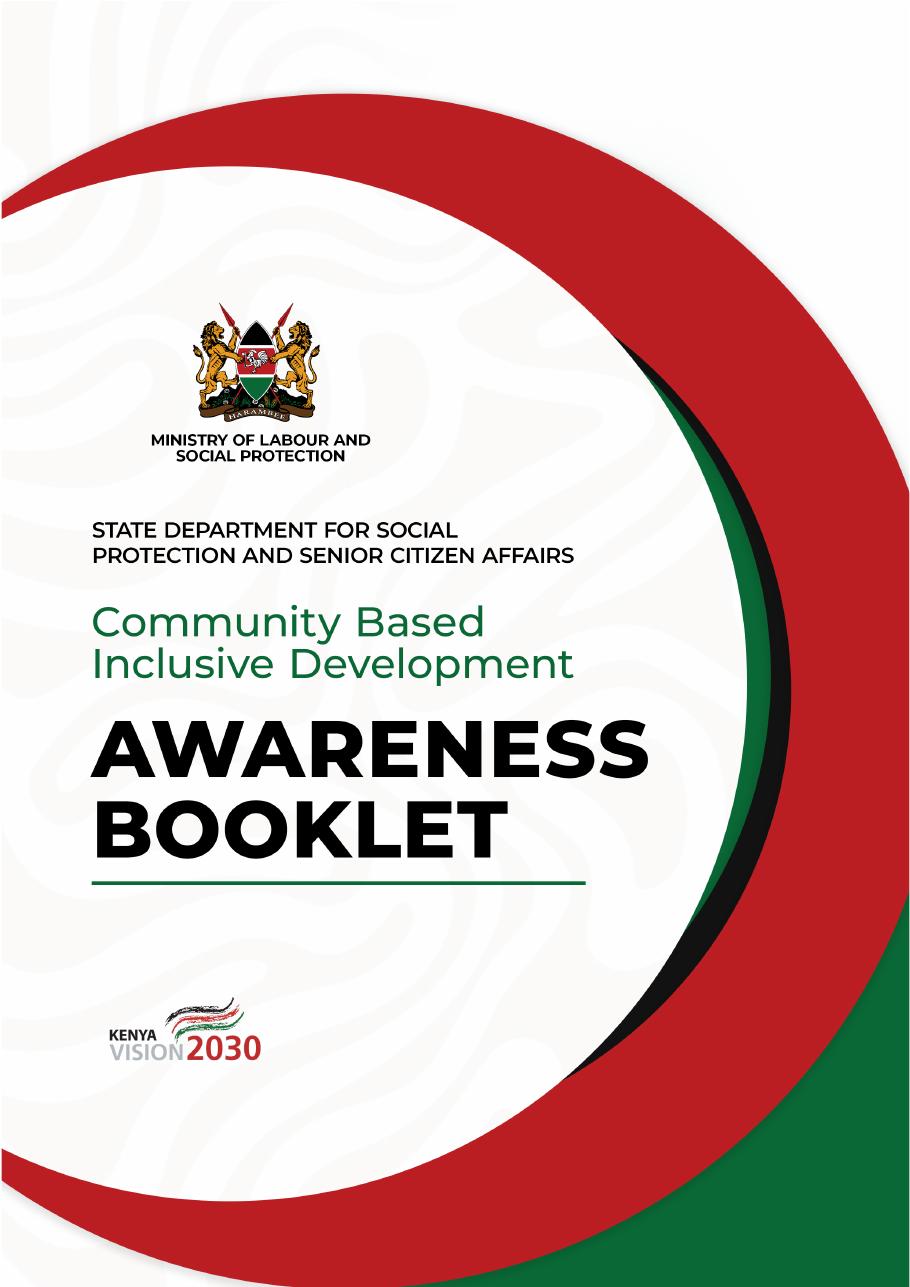
Cover of the CBID Awareness Booklet
About the booklet
- Title: CBID Awareness Booklet
- Publisher attribution: Ministry of Labour and Social Protection; State Department for Social Protection and Senior Citizen Affairs
- Printed on the back cover: Ministry of Labour and Social Protection, Social Security House, Bishops Road, P.O. Box 40326/16936 – 00100, Nairobi, Kenya. Fax: +254 (0) 2726222 / 2734417 (these numbers are labelled fax on the cover).
- Length: 44 pages
Foreword and acknowledgements
The booklet carries a Foreword signed by Dr. Alfred N. Mutua, EGH, Cabinet Secretary, Ministry of Labour and Social Protection, and Acknowledgements signed by Joseph M. Motari, CBS, Principal Secretary, State Department for Social Protection and Senior Citizen Affairs. They are named here as signatories of the booklet and not as current office-holders.
The Acknowledgements thank the technical working committee of state and non-state actors and name United Disabled Persons of Kenya, The Action Foundation, Christian Blind Mission and the Kenya Association for the Intellectually Handicapped. Christian Blind Mission and The Action Foundation are credited with financial support.