


Communication Support | Practical Guide
PECS Step-by-Step: Supporting Everyday Communication
Understand how the Picture Exchange Communication System introduces purposeful picture exchanges, develops communication skills and uses ongoing observation to guide the next steps.
Explore planning, the six PECS phases and progress monitoring through this introduction to the AFIRM guide.
Source: AFIRM / National Professional Development Center on ASD, 2016. This page is an introduction and is not PECS training.
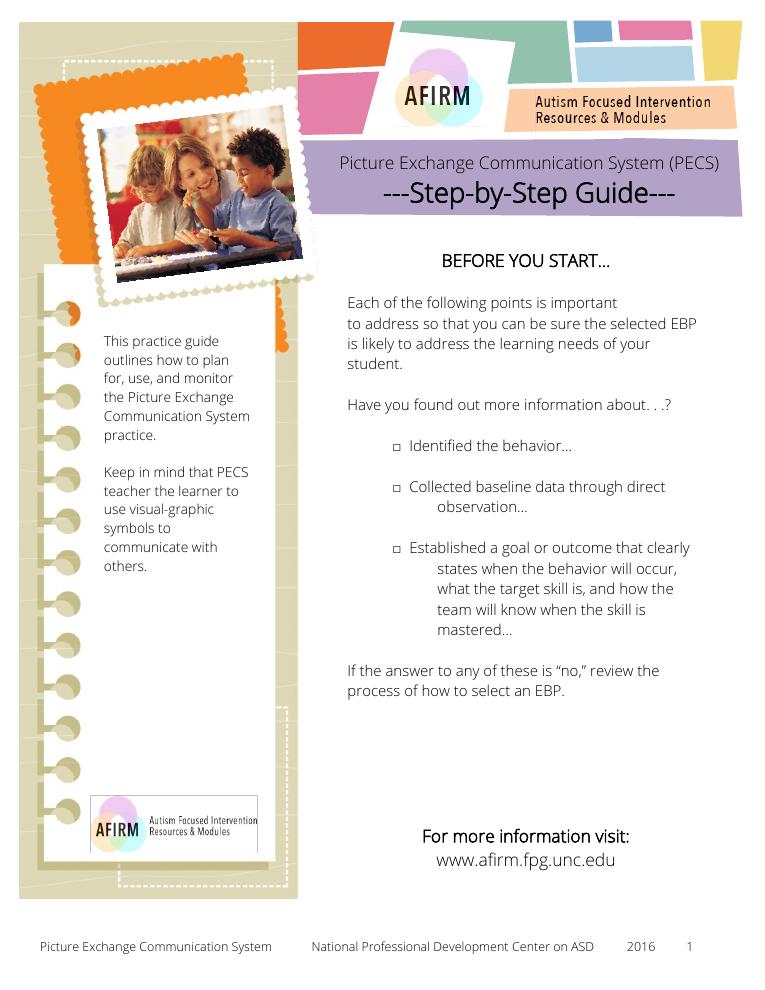
Page 1 of the original guide
THE APPROACH
What is PECS?
PECS is a structured augmentative and alternative communication (AAC) approach. A learner exchanges a picture with another person to communicate. Its main aim is functional communication, such as requesting and commenting.
1
Plan
Prepare the team, goals, materials and starting point.
2
Use
Teach through six phases, each with its own purpose.
3
Monitor
Collect information and review the next steps.
This overview accompanies the original practice guide. The guide states that it does not replace PECS training provided by Pyramid Educational Consultants. No particular outcome is promised, and not every learner will develop speech.
PLANNING
Prepare the people, materials and goals
These are preparation tasks for the supporting team. They are not tests a learner must pass before receiving communication support.
- Understand the learner’s current communication methods and needs.
- Agree on meaningful communication goals.
- Observe and record a starting point.
- Arrange appropriate PECS training for the supporting team.
- Identify preferred items and activities.
- Prepare suitable pictures or symbols and a communication book.
- Plan for use with different communication partners and in different settings.
Two supporting adults
The guide describes at least two adults during initial teaching: a communicative partner, who exchanges with the learner, and a helper, who assists the learner. Their roles are taught in PECS training.
Pictures and a communication book
No particular pictures or symbols are required. The guide suggests using those that are easiest to create and use, stored in a designated communication book, with a second copy planned for different settings and partners.
THE SIX PHASES
Explore the six PECS phases
Each phase has its own purpose. Examples are illustrative only.
1
Exchange a picture
Learn to give a picture to a communication partner to request a desired item or activity.
Illustrative example: A child hands a picture of a favourite snack to a partner.
Source: guide, page 3
2
Communicate across people and places
Develop more independent exchanges across partners, settings and distances.
Illustrative example: The learner takes a picture from the communication book to a partner in another room.
Source: guide, page 3
3
Choose between pictures
Select the picture that represents the intended request.
Illustrative example: Choosing between pictures of a drink and a toy to ask for the one wanted.
Source: guide, page 4
4
Build a simple sentence
Combine an “I want” symbol with a picture on a sentence strip.
Illustrative example: Placing “I want” and a picture of a ball on a strip and handing it over.
Source: guide, page 4
5
Respond to a request question
Use the picture system to answer “What do you want?”
Illustrative example: A partner asks the question and the learner answers using the sentence strip.
Source: guide, page 5
6
Make comments
Develop commenting, including responses using phrases such as “I see”, alongside spontaneous communication.
Illustrative example: A learner uses “I see” with a picture of a dog to comment.
Source: guide, page 5
More about each phase
Phase 1
The guide describes a structured setting with a helper supporting the learner, and gradually less assistance over time. The exact prompting is part of PECS training.
Phase 2
The guide describes more reinforcing items, more communication partners and more settings, so the exchange is not tied to one place or person.
Phase 3
The guide describes adding choices over time and checking that the learner receives what they asked for. How errors are handled is part of PECS training.
Phase 4
The guide describes introducing a sentence strip. How assistance is reduced is part of PECS training.
Phase 5
The guide describes responding to the question as a separate step from earlier phases. The question is not used in every phase.
Phase 6
The guide describes adding commenting questions and then reducing questions so that comments can happen spontaneously.
Physical prompting, error correction and decisions about moving to the next phase are matters for trained implementation. This page is a short summary, not a teaching protocol, and it sets no timelines or guarantees.
MONITORING
Notice progress and review the support
The guide recommends collecting information about target communication skills and using it to decide the next steps.
What to notice
- What the learner communicated.
- Whether the exchange was initiated independently.
- What support was needed.
- Which partner and setting were involved.
- Whether the preferred items or activities remained relevant.
When progress slows
Progress can slow for many reasons. Questions to ask, in a supportive way:
- Review the learner’s preferences.
- Check the pictures, materials and support provided.
- Review team training and consistency.
- Consider whether earlier skills need further support.
- Reconsider the approach with the supporting team when necessary.
The guide refers to separate sampling tools, implementation checklists and data resources. These are not included in this six-page PDF.
THE GUIDE
Read the Original Guide
The original document is unchanged.
Picture Exchange Communication System (PECS): Step-by-Step Guide
AFIRM / National Professional Development Center on ASD · 2016
PDF · 6 pages · approximately 368 KB
Pyramid’s training and resources
The AFIRM guide is separate from training and resources offered by Pyramid Educational Consultants. This page does not provide PECS training.
QUESTIONS
FAQs and Related Resources
Short answers, then related pages.
What does this guide cover?
Planning, using PECS across six phases, and monitoring progress. It is six pages long.
Is PECS the same as showing someone a picture?
No. PECS is a structured approach in which the learner actively exchanges a picture with a communication partner to communicate.
Does this webpage replace PECS training?
No. The guide itself says it does not replace training from Pyramid Educational Consultants, and neither does this page.
What materials does the guide discuss?
Pictures or symbols, a communication book with spare copies, preferred items and activities, and a sentence strip in later phases.
How should progress be reviewed?
By collecting information on target communication skills and using it, with the supporting team, to decide the next steps.
Related resources
NEXT STEP