


Kenya • CBID Strategic Framework 2026–2030
A shared plan for inclusive communities.
Explore Kenya’s framework for improving access to health, education, livelihoods and community life—and strengthening the participation of persons with disabilities and their families.
The Community Based Inclusive Development Strategic Framework brings together priorities, proposed actions and responsibilities to guide more inclusive communities.
Source document: Community Based Inclusive Development Strategic Framework 2026–2030, Ministry of Labour and Social Protection, State Department for Social Protection and Senior Citizen Affairs, as shown on its cover. This page is a reader’s guide to the Ministry’s framework. It is not authored by this website, and this website does not deliver the programmes described.
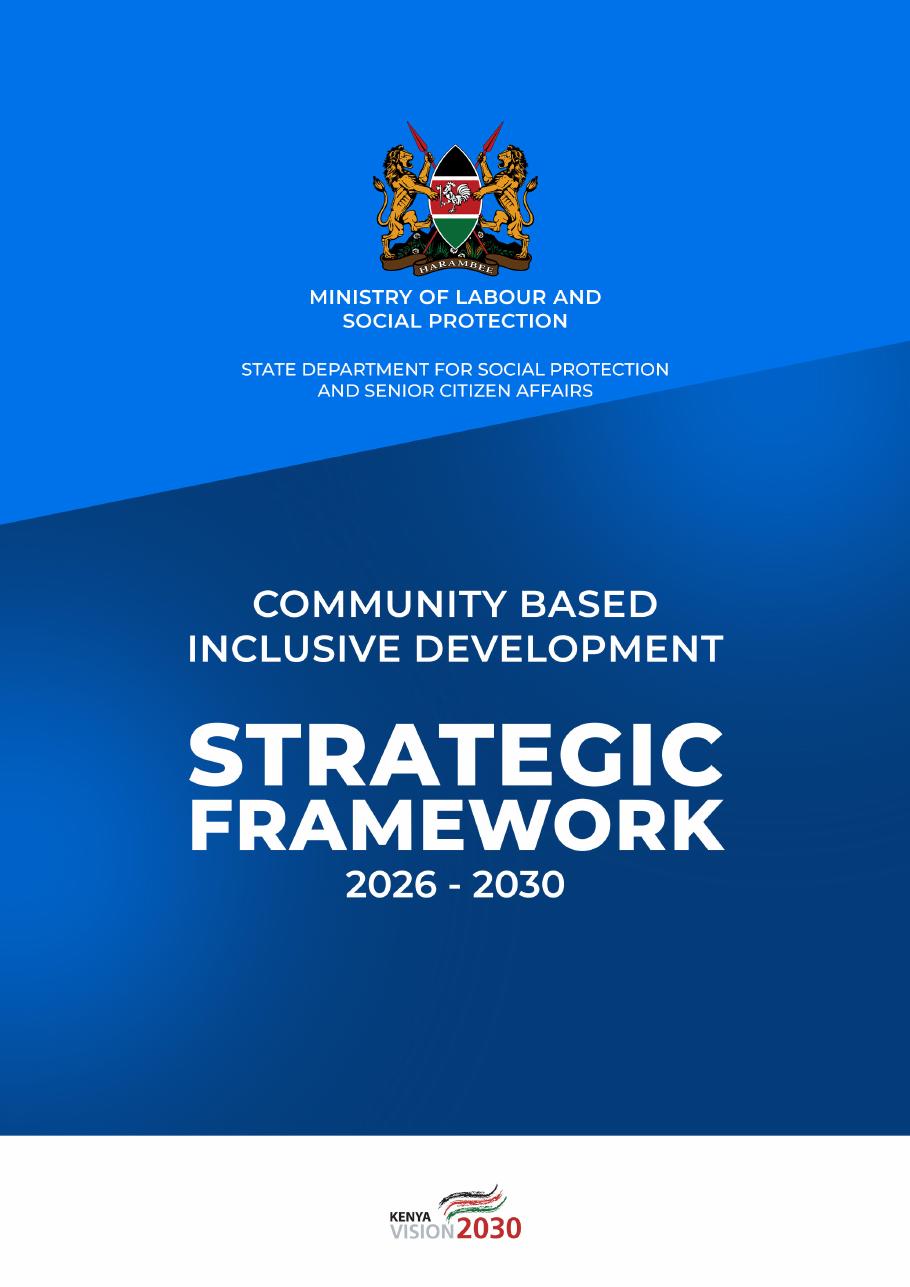
The framework cover (PDF)
WHY IT MATTERS
What the framework seeks to change
The framework is about everyday opportunities that many persons with disabilities and their families find hard to reach.
Healthcare and assistive technology
Reaching appropriate care and assistive technology.
Education and lifelong learning
Taking part in learning at every stage of life.
Skills and livelihood
Developing skills and earning a living.
Support and community life
Finding support and joining family and community life.
A voice in decisions
Having a say in decisions that affect one’s life.
THE FRAMEWORK’S VISION
“Persons with disabilities and their families live with dignity, independence, and equal opportunities as active members in the community.”
Framework section 1.2, PDF page 14
Mission
To promote an inclusive society where persons with disabilities and their families take part meaningfully in all aspects of life, enjoy equal rights, and access opportunities on an equal basis with others.
Framework section 1.3, PDF page 15
SEVEN CORE VALUES
InclusionDignityNon-DiscriminationSupportivenessTransparency and AccountabilityHonestyRespect
Framework section 1.4, PDF page 15
CBID in plain language
Community Based Inclusive Development (CBID) is an approach that brings persons with disabilities, families, communities and institutions together to remove barriers and support equal participation.
THE FIVE PRIORITIES
Five key result areas
The framework organises its work into five priorities, called Key Result Areas. Official names are shown with shorter labels used on this page.
1
Health
Accessible health services
Read the details →
2
Education and training
Inclusive education and training
Read the details →
3
Livelihood and protection
Improved livelihood, social protection, and community development
Read the details →
4
Social inclusion
Social inclusion
Read the details →
5
Empowerment
Empowerment of persons with disabilities and their families
Read the details →
1
PRIORITY 1 · HEALTH
Accessible health services
The framework’s goal is inclusive, comprehensive health services close to communities, so that persons with disabilities can enjoy the highest attainable standard of health.
Objective: PDF page 16 · Strategies: 17 · Annex I: 45 to 48
WHAT IT COVERS
Health promotionPreventionMedical careRehabilitationAssistive devices and technologiesSexual and reproductive health
PROPOSED ACTIONS
- Make health facilities, services and communication more accessible, with reasonable accommodation.
- Strengthen early identification and referral, including early childhood screening.
- Train health workers in disability inclusion, early identification and referral, and inclusive sexual and reproductive health.
- Strengthen referral and follow-up systems for rehabilitation.
- Build the capacity of local artisans and technicians to produce, adapt and repair affordable assistive technology.
- Involve persons with disabilities and OPDs in health decision-making and in monitoring accessibility.
Barriers the framework names
The framework names barriers such as costs of assessment and treatment, inaccessible transport, buildings and equipment, limited communication tools and health information, limited disability knowledge among health workers, and negative attitudes in communities.
2
PRIORITY 2 · EDUCATION AND TRAINING
Inclusive education and training
The framework’s goal is equitable access to inclusive education from early childhood to higher education, plus non-formal education and lifelong learning, so that persons with disabilities can reach their potential and take part in society.
Objective: PDF page 16 · Strategies: 17 and 18 · Annex I: 50 to 52
WHAT IT COVERS
Early childhoodPrimarySecondary and higherNon-formalLifelong learning
PROPOSED ACTIONS
- Make school infrastructure and transport accessible.
- Develop an adapted curriculum and specialised support services such as speech therapy, occupational therapy and counselling.
- Provide training for educators on inclusive teaching.
- Establish inclusive education resource hubs equipped with assistive technology and inclusive materials.
- Invest in early intervention, including early screening and assessment centres.
- Develop inclusive assessment tools that fit the adapted curriculum.
1
Early childhood
Early childhood care and education
2
Primary
Primary education
3
Secondary and higher
Secondary and higher education
4
Non-formal
Programmes outside the regular school system
5
Lifelong learning
Learning opportunities across life
Barriers the framework names
The framework names barriers such as inaccessible schools and materials, school fees and assistive-device costs for low-income families, long distances and inaccessible transport, no adapted curriculum for all learners, teachers who are not equipped, assessment methods that do not accurately measure progress, and negative attitudes.
The framework also describes financial assistance to families, including subsidising assistive devices and school-related expenses, as a proposed strategy. It does not say such assistance is available now.
3
PRIORITY 3 · LIVELIHOOD AND PROTECTION
Improved livelihood, social protection, and community development
The framework’s goal is to strengthen the economic independence and security of persons with disabilities through skills, work, financial services and social protection.
Objective: PDF page 16 · Strategies: 18 and 19 · Annex I: 53 and 54
WHAT IT COVERS
Skills developmentSelf-employmentWage employmentFinancial servicesSocial protection
PROPOSED ACTIONS
- Provide reasonable accommodation and promote accessible workplaces and accommodation policies.
- Offer entrepreneurship training, mentorship and business incubation tailored to persons with disabilities.
- Develop disability-friendly financial products and targeted financial inclusion programmes.
- Support community groups and organisations of persons with disabilities, including training and start-up capital.
- Simplify enrolment procedures and run outreach so that people can reach benefits that are available.
- Pilot a disability cash transfer, proposed in two counties. This is a plan to test an approach, not an open application or a guaranteed benefit.
Barriers the framework names
The framework names barriers such as unreliable disability statistics, inaccessible workplaces, workplace discrimination, exclusion from credit and loans, limited entrepreneurial skills and mentorship, inadequate coverage of social protection schemes, and complex registration procedures.
4
PRIORITY 4 · SOCIAL INCLUSION
Social inclusion
The framework’s goal is full inclusion in family and community life, with belonging, choice and participation in everyday activities.
Objective: PDF page 16 · Strategies: PDF page 19 · Annex I: 54
WHAT IT COVERS
Personal assistanceRelationships, marriage and familyCulture and artsRecreation, leisure and sportsJustice
PROPOSED ACTIONS
- Develop agreed standards for personal assistance and promote appropriate personal assistance services.
- Promote respite care services and develop social protection policies and programmes for caregivers.
- A feasibility study and cost analysis on a caregiver allowance. The framework does not establish an allowance.
- Strengthen peer support and link persons with disabilities to support networks in the community.
- Promote the use of culture and arts, and local recreation, leisure and sports.
- Raise awareness of the rights of persons with disabilities.
Barriers the framework names
The framework names barriers such as no nationally agreed definitions or standards for caregivers, few programmes that train and support caregivers, stigma and negative attitudes, physical barriers to public places and justice institutions, and limited knowledge of disability among law enforcers.
5
PRIORITY 5 · EMPOWERMENT
Empowerment of persons with disabilities and their families
The framework’s goal is for persons with disabilities to speak for themselves, make informed choices, lead and take part, with persons with disabilities remaining central as decision-makers and contributors.
Objective: PDF page 16 · Strategies: PDF page 20 · Annex I: 57 and 59
WHAT IT COVERS
Advocacy and communicationCommunity mobilisationPolitical participationCommunity groupsOrganisations of persons with disabilities
PROPOSED ACTIONS
- Provide accessible information, including alternative communication methods.
- Run awareness-raising publications and programmes that shift public perceptions.
- Train persons with disabilities on forming and taking part in community groups, including leadership and governance.
- Support mentorship and peer-learning programmes.
- Educate persons with disabilities on their right to take part in political life, and promote representation in governance structures.
- Strengthen and resource organisations for persons with disabilities.
Barriers the framework names
The framework names barriers such as attitudinal, institutional, cultural, policy and physical barriers, a lack of accessible communication channels in some areas, difficulty establishing community groups in urban settings, time and family or work responsibilities, and low participation in national discussions and politics.
Reading note. This page summarises the framework’s numbered strategic objectives, strategies and thematic chapters (Chapter Three). Proposed actions are plans. They are not open applications, services available today or guaranteed benefits.
IN PRACTICE
From priorities to practical action
Annex I turns each priority into activities. Here are five examples, one for each priority, shown as the matrix presents them.
In ordinary language: each action has an intended output, an indicator that counts it, a way to verify it, a timeframe and the organisations responsible.
1
Action
What is to be done
2
Output
What it should produce
3
Indicator
How it is counted
4
Verification
How it is checked
5
Timeframe
When it is planned
6
Responsible
Which organisations lead
PRIORITY 1 · HEALTH
Local capacity for assistive technology
- Proposed action
- Build the capacity of local artisans and community-based technicians to produce, adapt and repair affordable assistive technology, ensuring sustainable access for persons with disabilities.
- Intended output
- A local pool of trained artisans and technicians providing sustainable assistive technology services.
- Timeframe
- 2026-2027
Source: Annex I, PDF page 45
Indicator, verification and lead agencies
- Indicator
- Number of trained local artisans and technicians; number of persons with disabilities accessing locally made or repaired assistive technologies.
- Means of verification
- Training reports; list of trainees; assistive technology distribution list; maintenance logs.
- Lead agencies
- Ministry of Health; State Department for Social Protection (Directorate of Social Development); NCPWD; NFDK.
PRIORITY 2 · EDUCATION
Inclusive education resource hubs
- Proposed action
- Establish inclusive education resource hubs in selected counties.
- Intended output
- 10 functional resource centres equipped with assistive technologies and inclusive education materials established.
- Timeframe
- 2026-2028
Source: Annex I, PDF page 52
Indicator, verification and lead agencies
- Indicator
- Number of resource hubs established and operational.
- Means of verification
- Budgetary resource allocation; inventory records of materials and assistive technologies.
- Lead agencies
- MoE; KISE; KICD; NITA; State Department for Social Protection (Directorate of Social Development); NCPWD; OPDs; PBOs; Development Partners; UN Agencies; Private Sector; Commission for University Education; County Governments; CoG.
Annex II sets a three-year schedule for the same hubs: see the targets section below.
PRIORITY 3 · LIVELIHOOD AND PROTECTION
Reasonable accommodation in workplaces
- Proposed action
- Reasonable accommodation in workplaces: support employers.
- Intended output
- Adjustments provided.
- Timeframe
- 2026–2028
Source: Annex I, PDF page 53
Indicator, verification and lead agencies
- Indicator
- Number of workplaces adopting.
- Means of verification
- Inspection reports; employer records.
- Lead agencies
- State Department for Labour; FKE; KEPSA.
PRIORITY 4 · SOCIAL INCLUSION
Personal-assistance standards and respite care
- Proposed action
- Develop agreed standards for personal assistance; promote respite care services.
- Intended output
- Standards for personal assistance; respite care services.
- Timeframe
- 2026-2027
Source: Annex I, PDF page 54
Indicator, verification and lead agencies
- Indicator
- Number of standards; number of respite care services; number of caregivers supported.
- Means of verification
- Standards developed; respite care services available.
- Lead agencies
- State Department for Social Protection (Directorate of Social Development).
The same table lists a feasibility study on a caregiver allowance. It is a study, not an established payment.
PRIORITY 5 · EMPOWERMENT
Stronger organisations of persons with disabilities
- Proposed action
- Conduct capacity-building workshops for OPDs on governance, leadership and financial management.
- Intended output
- 30 OPDs trained on governance, leadership and financial management best practices.
- Timeframe
- 2026 – 2028
Source: Annex I, PDF page 59
Indicator, verification and lead agencies
- Indicator
- Number of OPDs trained; number of workshops conducted.
- Means of verification
- Training reports and attendance sheets; assessment results.
- Lead agencies
- State Department for Social Protection (Directorate of Social Development); UDPK; NCPWD; KNCHR; NGEC; PBOs; OPDs; UN Agencies; Development Partners; Private Sector.
These are selected examples. The complete matrix, with every strategy and activity, is in Annex I: Implementation Matrix for 2026–2030, which begins on PDF page 45 (printed page 42).
SHARED RESPONSIBILITY
Inclusion takes shared responsibility
Section 2.4 of the framework describes ten kinds of actors and what each is expected to contribute.
PEOPLE AND COMMUNITIES
Persons with disabilities and their families
Oversee the implementation of available opportunities; complement home-based rehabilitation and adapt the home environment; form OPDs or community groups; volunteer as collaborators; make sure persons with disabilities are registered and can reach available CBID programmes.
Organisations of persons with disabilities (OPDs)
Referral and follow-up, data collection and reporting, awareness raising, motivation, advocacy, linking with other sectors, and monitoring implementation of CBID.
Communities
Management and monitoring of CBID programmes.
LOCAL STRUCTURES
Community Social Development Promoters
Make sure rehabilitation and habilitation services are used by community members and are available for free or at affordable rates; advocate for national and county funding for CBID programmes.
Social Development Committees
Make sure annual surveys on needs are carried out; mobilise resources to help community groups; identify and document social development projects; offer advisory opinions on diversity and inclusion; mobilise persons with disabilities to form special interest groups.
Vocational Rehabilitation Committees
Make sure appropriate assistive technology and equipment are procured for vocational rehabilitation centres; increase enrolment of persons with disabilities; link trainees to economic empowerment opportunities.
GOVERNMENT AND COORDINATION
National and county governments
Enhance funding for CBID programmes; develop, review and implement policy.
Ministerial Inter Agency Coordinating and Advisory Committee (IACAC)
Monitor CBID programmes to prevent duplication and promote collaboration between the ministries, departments and agencies involved.
PARTNERS
Public Benefit Organizations
Local, regional, national and international organisations that collaborate with national and county governments in developing and implementing CBID programmes.
The private sector
Put in place mechanisms so employees can easily reach CBID programmes; support CBID programmes through corporate responsibility activities.
A KEY DISTINCTION
Organisations of persons with disabilities
Membership groups led and controlled by persons with disabilities to represent their rights and interests.
Organisations for persons with disabilities
Associations, groups, non-governmental organisations or societies formed to render services to persons with disabilities.
The CBID Advisory Committee
The framework describes the CBID Advisory Committee as a multi-stakeholder body set up to guide, coordinate and strengthen efforts to promote the rights, participation and inclusion of persons with disabilities. Its stated roles include:
- strategic direction and policy and technical advice
- coordination among government agencies, OPDs, civil society and development partners
- technical support, including capacity building
- support for resource mobilisation and partnerships
- monitoring, evaluating and documenting best practices and lessons learned
The framework lists members from the State Department for Social Protection, NCPWD, OPDs, county governments, civil society, development partners, academia, research institutions, community-based organisations and the private sector. It does not set out a reporting hierarchy, and this page does not assume one. Source: PDF page 10
Source: framework section 2.4, PDF page 24 and 25; definitions, PDF page 6.
MEASURING PROGRESS
What the framework plans to measure
Annex II sets out indicators, baselines and targets so that progress can be assessed.
The framework covers 2026–2030. Its results matrix presents a three-year target schedule for 2026–27, 2027–28 and 2028–29.
PLANNED TARGETS FROM THE FRAMEWORK (ANNEX II)
| Selected measure | Three-year target | 2026–27 | 2027–28 | 2028–29 | Source |
|---|---|---|---|---|---|
| Local artisans trained to make and repair assistive devices | 450 | 150 | 150 | 150 | PDF page 60 |
| Inclusive education resource hubs established and operational | 10 | 3 | 4 | 3 | PDF page 65 |
| Workplaces adopting reasonable accommodation | 100 | 20 | 40 | 40 | PDF page 66 |
| Parents trained | 1,200 | 400 | 400 | 400 | PDF page 68 |
How to read these figures
Indicators, baselines and targets describe how progress is intended to be assessed. They are planned targets, not evidence that activities have happened. This page shows no achievement counters or completion figures, because the framework contains none.
Units and totals
Each figure is a count in the matrix’s own unit. Counts for different groups are separate and are not added together here. Targets are shown only for the three years the matrix supplies.
The complete results matrix is Annex II: Monitoring and Evaluation / Results Matrix, which begins on PDF page 60 (printed page 57).
OPPORTUNITIES AND CHALLENGES
What can support or hinder delivery
The situation analysis in Chapter Two sets out strengths, weaknesses, opportunities and threats for implementing CBID.
Strengths
- Political goodwill
- Supportive environment from non-governmental organisations, development partners and the private sector
- Existing legislation
- Funding from the international community
- Strong government commitment and multisectoral collaboration
- Existence of a Council for persons with disabilities
Weaknesses
- Inadequate human and financial resources to implement policy directives
- Lack of systematic inter-governmental coordination and communication
- Budget cuts from government
- Lack of disaggregated data for persons with disabilities
- Unfulfilled financial commitments by some partners
- Inadequate coverage of social protection programmes
- Duplication of roles and responsibilities
Opportunities
- Partnerships with development partners
- Affirmative action
- Fundraising through the National Budgeting Process
- Support from sources other than government funding
Threats
- Change of government priorities
- Political instability
- Humanitarian emergencies leading to redirection of funds
SWOT analysis as presented in the framework, PDF page 22 (printed page 19).
The wider context. The framework also reviews the policy, political, economic, social, technological, environmental and legal context (PESTEL), including coordination between state and non-state actors, budget allocation, information systems, emergencies and climate change, and the legal framework. The detailed analysis is in the PDF, PDF page 22 to 24. The framework does not give a costed implementation budget or funding allocations, and this page adds none.
NEXT STEPS
Read, download and explore further
The full framework has the detail that this page summarises.
Cover of the framework
About this document
- Title: Community Based Inclusive Development Strategic Framework 2026–2030
- Framework period: 2026–2030
- Publisher attribution: Ministry of Labour and Social Protection, State Department for Social Protection and Senior Citizen Affairs
- File format: PDF, 70 pages
- Contents of the PDF: Chapters One to Three, then Annex I (Implementation Matrix, from PDF page 45) and Annex II (Results Matrix, from PDF page 60)
RELATED RESOURCES ON THIS SITE
CBID Awareness Booklet
The earlier resource page on the CBID approach and its five components.
Persons with Disabilities Act, 2025
Full-text reading pages for the Act.
Status of Disability in Kenya
Background on disability in Kenya.
The Constitution of Kenya, 2010
The Constitution on this site.
This page is a reader’s guide to the Ministry’s framework. It is not authored by this website, and this website does not deliver the programmes described. Statistics and legal references are statements in the source document.