


Research & Insights | Kenya
Autism in Kenya: Understanding Needs, Improving Support
Understand the barriers facing autistic people, people with related developmental disabilities and their families—and explore the changes recommended to improve access to care, education, livelihoods and community participation.
A practical introduction to the National Council for Persons with Disabilities’ analytical monograph.
This page summarises a research report. It is not a diagnosis tool, an assessment or an application process, and every person’s experience and support needs are different.
Illustration created for this page
KEY FINDINGS
What did participants identify?
These are findings reported by the study’s respondents and informants. They are not universal experiences, and they are not a current assessment of every service in Kenya.
Access to assessment and support
Participants described difficulties getting timely identification, appropriate referrals and skilled services, including too few trained practitioners and therapy centres.
Why it matters: The report notes that earlier identification can help children and families reach support sooner.
Source: NCPWD monograph, pp. 30–31
Costs and household pressures
Families reported extra expenses for therapies, medication, assistive products, communication aids and everyday care. Costs vary between conditions.
Why it matters: Extra costs can place real pressure on household budgets and caregivers’ time.
Source: NCPWD monograph, pp. 3, 30
Stigma and exclusion
Participants reported misunderstanding, labelling and discrimination that affected their participation and their families’ experiences.
Why it matters: Limited awareness can keep people out of community life and discourage families from seeking support.
Source: NCPWD monograph, pp. 31–32
Education and transitions
Participants identified gaps in individualised learning support, teacher training and pathways beyond school.
Why it matters: Without suitable support, learners can leave school without a clear route into training or work.
Source: NCPWD monograph, pp. 32–33
Employment and livelihoods
The report describes barriers to fair employment, workplace accommodations and economic participation, including reports of exploitation.
Why it matters: Fair work and accommodations affect independence and family income.
Source: NCPWD monograph, p. 32
Access to justice
Communication barriers and difficulty understanding legal processes were identified, along with a lack of intermediaries such as communication aides.
Why it matters: People need to understand and take part in processes that affect their rights.
Source: NCPWD monograph, p. 33
RECOMMENDED IMPROVEMENTS
Four priorities for better support
Chapter 5 of the report proposes a programme design for the National Council for Persons with Disabilities.
Recommendations in the report
1
Earlier identification and coordinated support
Map providers, strengthen referral arrangements, develop guidance and improve professional training.
2
Access to health and social care
Improve connections to services, affordability and access to appropriate support and assistive products.
3
Livelihoods and caregiver support
Encourage inclusive employment, entrepreneurship opportunities and caregiver peer groups.
4
Inclusive education
Strengthen learning accommodations, coordination and opportunities for learners with autism and related developmental disabilities.
Cross-cutting priorities
Awareness and advocacy · Capacity building · Partnerships
These are proposed activities described in the report (pages 34–38). They do not mean that the programmes, scholarships, insurance arrangements or services are already available.
USING THE FINDINGS
What can you take from this report?
Three starting points. These are practical discussion prompts inspired by the report. They are not an assessment, a diagnosis tool or an official application process.
For individuals, families and caregivers
- Which daily activities or learning situations need more support?
- What communication preferences should professionals understand?
- Which services are available locally, and how do referrals work?
- What are the costs and practical arrangements?
- What support is needed for the next stage of education or adult life?
For educators and service providers
- Individualised accommodations
- Accessible communication
- Coordination with families
- Planning for transitions
For organisations and programme planners
- Service mapping and identifying local gaps
- Involving autistic people in decisions
- Supporting caregivers
- Monitoring whether access improves
Needs differ from person to person, and autistic people should take part in decisions about their own support.
ABOUT THE STUDY
Whose experiences informed the report?
Table 4.2 on page 25 of the report lists these respondent groups.
208
caregivers
28
teachers
14
respondents categorised as persons with ASD and related developmental disabilities
8
other respondents
Together these make 258 respondents in that table. The research also used interviews and focus groups, so 258 is not the total number of participants across every method.
Caregivers made up most respondents in this table. The findings offer insight into participants’ experiences and priorities; they should not be used to estimate autism prevalence across Kenya.
How the research was carried out
The report describes the use of questionnaires together with key informant interviews, in-depth interviews and focus group discussions. Planned sample sizes in the report are separate from the respondent counts above, and this page does not use them as results.
What this page leaves out on purpose
The report contains figures whose totals, percentages and charts do not always agree. This page therefore keeps cost findings qualitative and does not highlight percentages or county counts. It also does not repeat the report’s older prevalence statement as a current figure for Kenya or the world.
Why inclusive learning support matters
In the education findings, Sylvia Mochabo, identified in the report as founder of Andyspeaks, a parent of children with neurodiverse disabilities and a Board Member of the National Council for Persons with Disabilities, said that the lack of support services such as speech therapy, occupational therapy and behavioural interventions can “hinder the progress” of learners with ASD and related developmental disabilities in the education system. This is a paraphrase.
Source: NCPWD monograph, page 32. The role is as recorded in the report. This is a contribution to the research and not an endorsement of this website.
SOURCE AND LANGUAGE
About the Source and How This Page Talks About Autism
The report is by the National Council for Persons with Disabilities (NCPWD). The official download listing is dated 30 January 2024. That is the listing date and not a fieldwork date.
Respectful language
Needs differ. The report’s findings are not a description of every autistic person, and this page does not suggest cures or blame families. Not every condition discussed in the report is a form of autism.
Historical context
References in the report to NHIF arrangements, the 2003 legislation and proposed 2023 bills are background from when it was written. Check current official sources before relying on eligibility, legal rights or application steps.
THE FULL REPORT
Read the Report
The original document is unchanged.
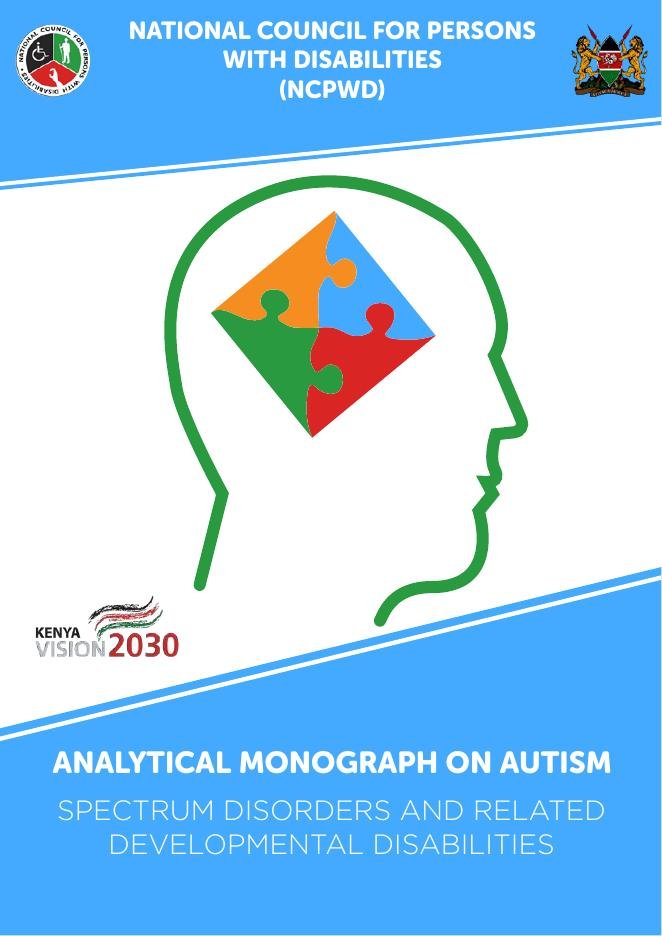
Cover of the report
Analytical Monograph on Autism Spectrum Disorders and Related Developmental Disabilities
Source: National Council for Persons with Disabilities (NCPWD).
PDF · 42 pages · about 1.5 MB
This is the supplied file. The official download may differ, so check the NCPWD listing too.
NEXT STEP
Turn understanding into informed next steps.
Read the report, talk with the people who support you and explore related resources on this website.