


Research & Insights | Kenya
Autism in Kenya: Understanding Needs, Improving Support
Explore what this Kenyan study reveals about access to care, education, livelihoods and community participation—and the improvements it recommends for autistic people, people with related developmental disabilities and their families.
Based on the National Council for Persons with Disabilities’ 2024 analytical monograph.
This page summarises a research report. It is not a diagnosis tool, an assessment or an application process, and every person’s experience and support needs are different.
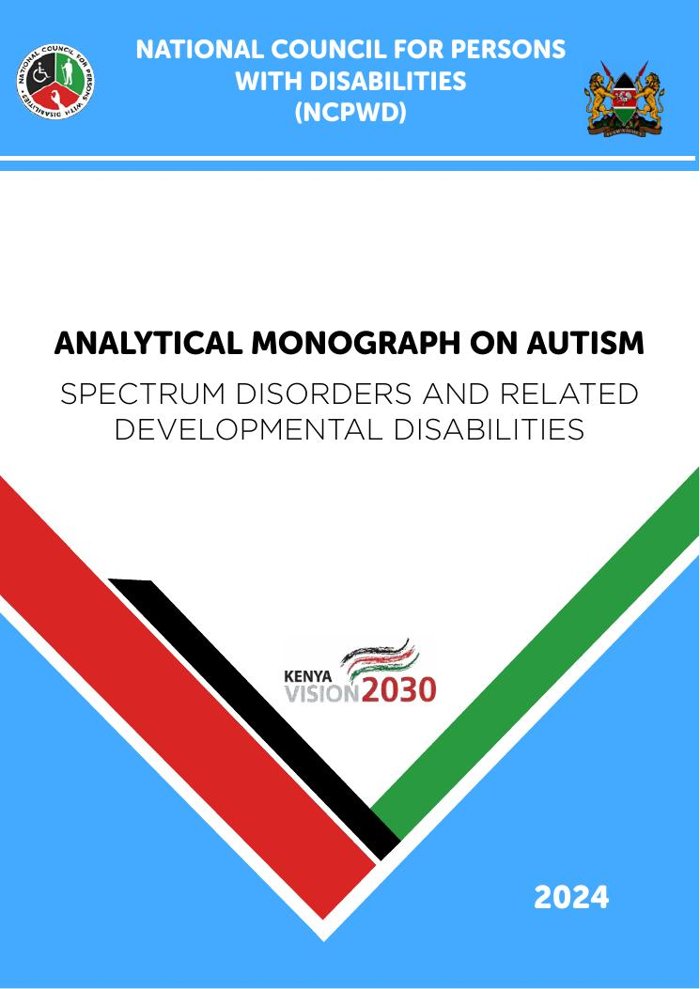
Cover of the 2024 report. Artwork and attribution: NCPWD.
KEY FINDINGS
What did the study highlight?
These are findings reported by the study’s respondents and informants. They are not universal experiences, and they are not a current assessment of every service in Kenya.
Access to assessment and support
Participants described difficulties getting timely identification, appropriate referrals and skilled services, including too few trained practitioners and therapy centres.
Why it matters: The report notes that earlier identification can help children and families reach support sooner.
Source: NCPWD monograph, pp. 31
Costs and household pressures
Families reported extra expenses for therapies, medication, assistive products, communication aids and everyday care. Costs vary between conditions.
Why it matters: Extra costs can place real pressure on household budgets and caregivers’ time.
Source: NCPWD monograph, pp. 3, 29–30
Stigma and exclusion
Participants reported misunderstanding, labelling and discrimination that affected their participation and their families’ experiences.
Why it matters: Limited awareness can keep people out of community life and discourage families from seeking support.
Source: NCPWD monograph, pp. 31–32
Education and transitions
Participants identified gaps in individualised learning support, teacher training and transition planning beyond school. The report adds that some learners may do better in specialised settings, and that decisions should reflect individual needs.
Why it matters: Without suitable support, learners can leave school without a clear route into training or work.
Source: NCPWD monograph, pp. 32–33
Employment and livelihoods
The report describes barriers to fair employment, workplace accommodations and economic participation, including reports of exploitation.
Why it matters: Fair work and accommodations affect independence and family income.
Source: NCPWD monograph, p. 34
Access to justice
Participants and the report describe communication difficulties, overwhelming legal settings and limited understanding among legal professionals as barriers to accessing justice.
Why it matters: People need to understand and take part in processes that affect their rights.
Source: NCPWD monograph, pp. 34–35
RECOMMENDED IMPROVEMENTS
Four priorities for better support
Chapter 5 of the report proposes a programme design. These are the report’s recommendations, not services you can automatically claim.
Recommendations in the report
1
Earlier identification and coordinated support
Map providers, strengthen referral arrangements, develop guidance and improve professional training.
2
Access to health and social care
Improve connections to services, affordability and access to appropriate support and assistive products.
3
Livelihoods and caregiver support
Encourage inclusive employment, entrepreneurship opportunities and caregiver peer groups.
4
Inclusive education
Strengthen learning accommodations, coordination and opportunities for learners with autism and related developmental disabilities.
Cross-cutting priorities
Awareness and advocacy · Capacity building · Partnerships
These are proposed activities described in the report (printed pages 36–39). They do not mean that the programmes, scholarships, insurance arrangements or services are already available.
USING THE FINDINGS
How can you use these findings?
Three starting points. These are practical discussion prompts inspired by the report. They are not an assessment, a diagnosis tool or an official application process.
For individuals, families and caregivers
- Which daily activities or learning situations need more support?
- What communication preferences should professionals understand?
- Which services are available locally, and how do referrals work?
- What are the costs and practical arrangements?
- What support is needed for the next stage of education or adult life?
For educators and service providers
- Individualised accommodations
- Accessible communication
- Coordination with families
- Planning for transitions
For organisations and programme planners
- Service mapping and identifying local gaps
- Involving autistic people in decisions
- Supporting caregivers
- Monitoring whether access improves
Needs differ from person to person, and autistic people should take part in decisions about their own support.
ABOUT THE STUDY
Whose experiences informed the report?
Table 4.2.1 on printed page 23 of the report (PDF page 33) lists these respondent categories.
222
persons with ASD, related developmental disabilities and representative caregivers, grouped together
28
caregiving teachers
8
other respondents, such as therapists, cooks and drivers
Total: 258 respondents in this table. The first group combines people with ASD or related developmental disabilities and representative caregivers, so it should not be read as 222 autistic respondents. The research also used interviews and focus groups, so 258 is not the confirmed total across every method.
These findings describe the experiences and priorities reported in this study. They should not be used to estimate autism prevalence across Kenya.
How the research was carried out
The report describes the use of questionnaires together with key informant interviews, in-depth interviews and focus group discussions. Planned sample sizes in the report are separate from the respondent counts above, and this page does not use them as results.
What this page leaves out on purpose
The report contains figures whose totals, percentages and charts do not always agree. This page therefore keeps cost findings qualitative and does not highlight percentages or county counts. It also does not repeat the report’s older prevalence statement as a current figure for Kenya or the world.
Why inclusive learning support matters
In the education findings, Sylvia Mochabo, identified in the report as founder of ‘Andy Speaks 4 Special Needs Persons Africa’, a parent of children with neurodiverse disabilities and a Board Member of the National Council for Persons with Disabilities, said that the lack of support services such as speech therapy, occupational therapy and behavioural interventions can “hinder the progress” of learners with ASD and related developmental disabilities in the education system. This is a paraphrase.
Source: NCPWD monograph, printed page 33. The role is as recorded in the report. This is a contribution to the research and not an endorsement of this website.
SOURCE AND LANGUAGE
About the Source and How This Page Talks About Autism
The report is by the National Council for Persons with Disabilities (NCPWD). The report is dated 2024. The official NCPWD download listing is dated 30 January 2024; that is the listing date, not a fieldwork date.
Respectful language
Needs differ. The report’s findings are not a description of every autistic person, and this page does not suggest cures or blame families. Not every condition discussed in the report is a form of autism.
Historical context
References in the report to NHIF arrangements, the 2003 legislation and proposed 2023 bills are background from when it was written. Check current official sources before relying on eligibility, legal rights or application steps.
THE FULL REPORT
Read the Report
The original document is unchanged.
Cover of the report
Analytical Monograph on Autism Spectrum Disorders and Related Developmental Disabilities
Source: National Council for Persons with Disabilities (NCPWD), Kenya.
Year: 2024
PDF · 54 pages · approximately 15 MB
The official download may differ from this file, so check the NCPWD listing too.
NEXT STEP
Turn understanding into informed next steps.
Read the report, talk with the people who support you and explore related resources on this website.