


KENYA • DISABILITY ASSESSMENT RESOURCE
Understanding disability assessment in Kenya.
Explore how the 2022 guidelines describe disability assessment, the areas professionals consider and the relationship between health, everyday activities and participation.
A clear introduction for persons with disabilities, families and caregivers, with reference information for professionals.
Disability Medical Assessment and Categorization Guidelines, Ministry of Health, Republic of Kenya. Cover year: 2022. Supplied copy marked “Draft.”
This overview explains the supplied 2022 Ministry of Health document, which is marked “Draft.” For current assessment and registration requirements, consult the relevant official services.
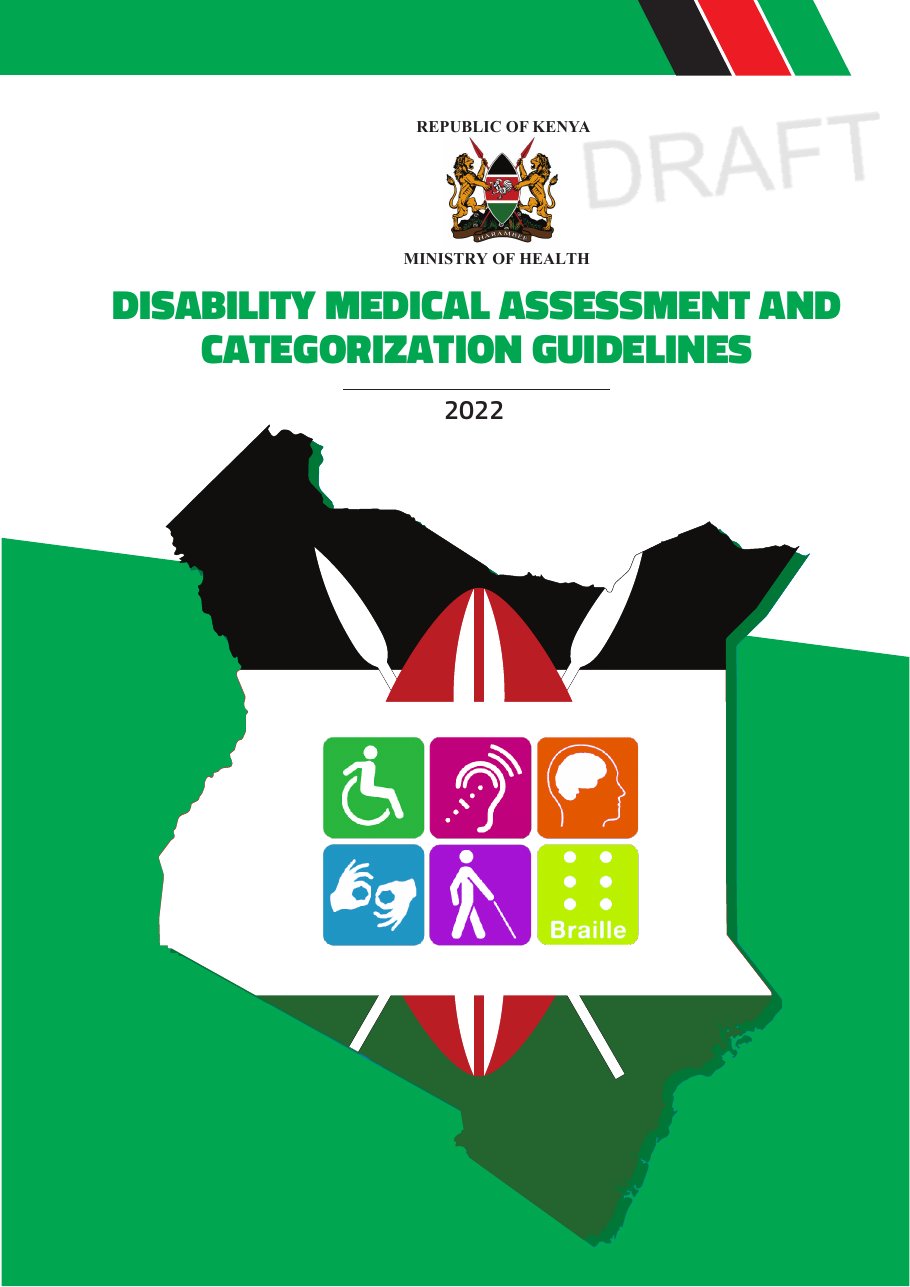
Cover of the supplied document, including its “Draft” watermark
THE APPROACH
Looking at the person’s everyday experience
The guidelines look beyond the diagnosis to how a person lives, moves, communicates and takes part.
Body functions and structures
The health-related changes or impairments being assessed.
Activities and participation
How the person carries out tasks and takes part in home, school, work and community life.
Environmental factors
How surroundings, accessibility, support and barriers affect participation.
Personal circumstances
Relevant individual circumstances considered during assessment.
How the areas fit together. The guidelines adapt the World Health Organization’s International Classification of Functioning, Disability and Health (ICF). It brings together medical, individual and social perspectives. A health condition is one part of the picture. What a person can do, where they live, what support and barriers they meet, and their own circumstances all shape how they take part in daily life. A diagnosis on its own does not decide a person’s support needs, a disability rating or any registration outcome.
Plain-language glossary
Impairment
A problem in the function or structure of the body due to a health condition.
Activity limitation
Difficulty a person may have in carrying out a task or action.
Participation restriction
A problem a person may have in being involved in life situations such as school, work or community life.
Functional assessment
A review of what a person can and cannot do in daily life, used alongside health information.
Activities of daily living
The basic tasks that need doing every day, such as washing, dressing and eating. The guidelines use them as a measure of a person’s functional status.
ICF
The World Health Organization’s International Classification of Functioning, Disability and Health, the framework the guidelines are built on.
This overview explains the supplied 2022 Ministry of Health document, which is marked “Draft.” For current assessment and registration requirements, consult the relevant official services.
SIX BROAD DOMAINS
What the assessment areas cover
The document organises disability into six broad domains. Open a card for a short explanation of what its section covers.
Physical disabilities
Looks at movement, strength, coordination, dexterity and how they affect everyday activities.
PDF page 24 of the supplied document
Read more
Physical and rehabilitation professionals carry out the assessment, using the guidelines’ own measures. Measurement methods and scoring stay in the source document.
Source section begins on PDF page 24 of the supplied document.
Visual impairments
Addresses aspects of vision and how they affect functioning and interaction with the environment.
PDF page 46 of the supplied document
Read more
Eye specialists assess vision. Visual-acuity calculations and registration recommendations stay in the professional source material.
Source section begins on PDF page 46 of the supplied document.
Hearing, speech and language disabilities
Two clearly labelled parts: hearing, and speech, language, communication and swallowing.
PDF pages 49 and 55 of the supplied document
Read more
Hearing (source begins on PDF page 49). Considers types and degrees of hearing loss and how hearing affects communication, social interaction and learning. Eye, ear and hearing professionals are involved.
Speech, language, communication and swallowing (source begins on PDF page 55). Considers how a person speaks, understands and uses language, communicates with others and swallows. Speech and language therapists and related professionals are involved.
The source groups these under one broad domain with separate sections for each part.
Sections begin on PDF pages 49 and 55 of the supplied document.
Mental health, intellectual disability and autism
A broad grouping that contains distinct conditions with different assessment considerations.
PDF page 63 of the supplied document
Read more
The chapter covers mental health conditions, intellectual disability and autism spectrum disorders, and also discusses attention deficit hyperactivity disorder (ADHD) and specific learning disorders. They are different things: autism does not necessarily involve intellectual disability, and the terms are not interchangeable. For learning-related assessment, the source mentions school progress reports and reports from the Educational Assessment and Resource Centre (EARC). Diagnostic criteria and some historical terminology stay in the source document.
Source section begins on PDF page 63 of the supplied document.
Progressive chronic conditions
Considers health history, functional limitations, participation and support needs for conditions that worsen over time.
PDF page 71 of the supplied document
Read more
The source describes these conditions as ones that get worse over time and may need different support as they change. Not every chronic illness automatically qualifies a person for disability registration.
Source section begins on PDF page 71 of the supplied document.
Maxillofacial disabilities
Conditions involving the mouth, jaws, face and related structures that affect their functions and everyday activities.
PDF page 96 of the supplied document
Read more
“Maxillofacial” refers to the jaws and face. The section looks at how such conditions affect functions such as eating, speaking and daily life. Dental or maxillofacial professionals lead this assessment.
Source section begins on PDF page 96 of the supplied document.
These summaries are for orientation only. They are not checklists, and they do not produce a diagnosis or an eligibility result. Each domain uses its own methods and scoring in the source document.
THE PROCESS
How professional assessment is organised
A general overview of the document’s approach. It is not a guaranteed current application procedure.
1
Review history and everyday functioning
Relevant health history and information about how the person manages daily life are reviewed.
2
Carry out domain-specific assessments
Appropriate assessments are carried out for the relevant domain.
3
Review and document findings
The assessment team reviews and documents what was found.
4
Recommend, refer and report
Recommendations, referrals and reports are provided for the relevant authorities.
Who may be involved
Examples of the kinds of professionals the document mentions:
- Medical officers
- Rehabilitation professionals, such as physiotherapists and occupational therapists
- Eye and hearing specialists
- Speech and language therapists
- Mental health professionals
- Dental and maxillofacial professionals
Assessment committees
The 2022 document describes disability assessment committees with at least three members, including a specialist in the relevant disability domain. It also sets out arrangements for appropriately qualified personnel when a specialist is not available, and says members must be registered and licensed.
Keep these apart
Assessment, diagnosis, registration and decisions about individual services are different steps. This page does not promise registration, a certificate, tax exemption, funding or other benefits for any diagnosis or score.
BEFORE YOU GO
Questions to ask your assessment facility
Useful questions for persons with disabilities, families and caregivers to raise before an assessment.
Questions to ask your assessment facility
- Does this facility provide the assessment I need?
- Which existing reports or records should I bring?
- Which professionals may be involved?
- What communication or accessibility support can be arranged?
- How will the findings and recommendations be explained?
- What happens after the assessment?
What may be considered
Relevant medical history, previous assessments and information about everyday functioning may be considered. For learning-related assessments the document also mentions school progress and Educational Assessment and Resource Centre (EARC) reports.
Requirements differ, so confirm them with the facility. This page does not give a universal paperwork list, fee or processing time.
PROFESSIONAL REFERENCE
Assessment forms and professional reference
An index for professionals. It is not for completing online.
Open the index of forms and reference material
These are the forms and reference annexes in the supplied 139-page PDF, listed by their PDF page numbers. The document’s own contents list uses different page numbers.
Reference material in the supplied document
| Reference material | PDF pages |
|---|---|
| Visual impairment assessment form | 108–110 |
| Visual acuity conversions and visual functional assessment | 111–113 |
| Physical disabilities assessment form | 114–116 |
| Hearing assessment form | 117–118 |
| Speech, language, communication and swallowing assessment | 119–123 |
| Mental health, intellectual disability and autism assessment | 124–126 |
| Progressive chronic disorders assessment | 127–129 |
| Maxillofacial assessment | 130–131 |
| ICF domain coding and WHODAS-related reference | 132–135 |
The forms are for professional assessment and documentation. This website does not collect medical records or identification documents, and it has no calculators, tests or eligibility checkers. Scoring systems, formulas and clinical thresholds differ between domains and stay in the source document.
FAQ
Common questions
Short answers for orientation. This is not personal medical advice.
What is this document designed to explain?
It provides a standard process and common language for assessing and categorising disability in approved health facilities, organised using the ICF. It is mainly written for medical personnel and relevant authorities.
Is disability assessment the same as receiving a diagnosis?
No. A diagnosis describes a health condition. The guidelines also look at everyday activities, participation, surroundings and personal circumstances.
Does this document address children as well as adults?
The document mentions children in several places, for example in hearing and in learning-related assessment, and it refers to school progress and EARC reports. Details for any individual child are best discussed with the assessment facility.
Does an assessment automatically guarantee registration or benefits?
No. An assessment is one step. Registration and any services are decided by the relevant authorities under their own rules.
Where should I check current requirements?
Check with the assessment facility and the National Council for Persons with Disabilities (NCPWD). Its FAQs cover assessment-report requirements and registration instructions.
This FAQ is based on the supplied 2022 document, which is marked “Draft.” For current procedures, rely on official services.
SOURCE AND FURTHER HELP
Where to go next
This page explains a Ministry document. It is not an assessment centre or a government registration service.
About the supplied document
- Title: Disability Medical Assessment and Categorization Guidelines
- Attribution: Ministry of Health, Republic of Kenya
- Year on the cover: 2022
- Status of the supplied copy: Draft
- Format: PDF
- Length: 139 PDF pages
The document carries a reproduction restriction, so this website does not host or offer it for download.
RELATED RESOURCES ON THIS WEBSITE
CBID Awareness Booklet
Understanding community-based inclusive development.
CBID Training Manual
Practical learning modules for inclusion.
CBID Strategic Framework 2026–2030
Strategic direction and planned measures.
The supplied copy has some inconsistencies, for example between the cover year and the publication text, and the document is marked Draft. For current requirements, consult the relevant official services.