


Disability-Inclusive Language Guidelines
Words That Welcome. Language That Includes.
Explore practical ways to communicate about disability with respect, clarity and confidence—in everyday conversations, learning environments and written content.
Source: United Nations Office at Geneva, prepared to support the UN Disability Inclusion Strategy. This page is a short overview of the 11-page PDF.
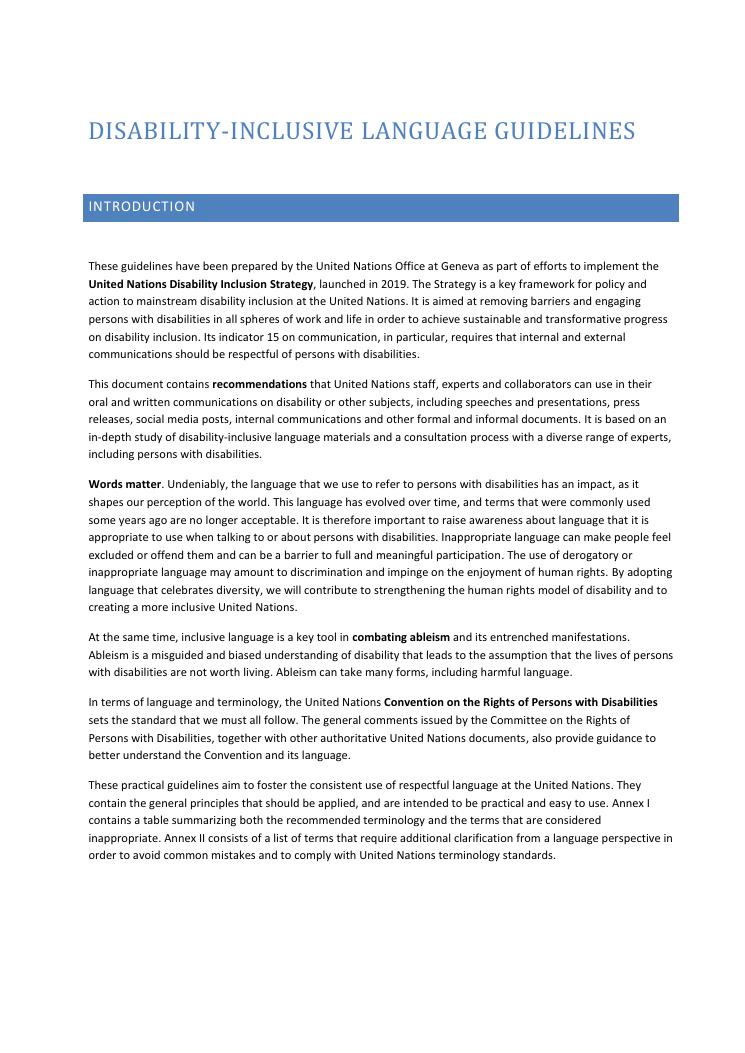
Page 1 of the original guidelines
FIVE PRINCIPLES
Five principles for respectful communication
Practical starting points drawn from the guidelines. They are not a script, and individual preferences always come first.
Respect how people describe themselves
The guidelines favour people-first wording, such as “persons with disabilities”, with some exceptions: for example, “blind person” and “deaf person” are also accepted. If in doubt, ask how the person or group chooses to identify.
Describe people without stereotypes
Disability is part of human diversity. Avoid assumptions about someone’s abilities, quality of life or personality, and avoid calling people “inspirational” or “brave” simply for living their lives.
Use clear, direct language
Terms such as “differently abled” or “special needs” are intended to soften disability, but the guidelines say they can sound patronising. “Persons with disabilities” is more neutral.
Avoid automatic pity or tragedy
Disability is not an illness or a problem to be fixed. Say a person “has” a disability rather than “suffers from” one, and avoid calling someone a “victim” of a condition.
Carry respect into everyday conversation
Everyday phrases such as “let’s go for a walk” are fine. Avoid disability-related terms as insults or casual criticism, such as using “lame” to mean boring.
EXAMPLES
Small wording changes, clearer meaning
Examples based on Annex I and the general principles. Context and personal preference still matter.
Wording to reconsider
Consider instead
Why it matters
Wording to reconsider
“differently abled”, “special needs”
Consider instead
“person with a disability”; “tailored assistance” instead of “special assistance”
Why it matters
Euphemisms can suggest that disability needs softening.
Wording to reconsider
“suffers from”, “afflicted with”
Consider instead
“has [a disability]” or “is [blind / deaf]”
Why it matters
The first set suggests constant pain and a poor quality of life.
Wording to reconsider
“wheelchair-bound”, “confined to a wheelchair”
Consider instead
“wheelchair user”
Why it matters
A wheelchair is a tool that enables movement.
Wording to reconsider
“the blind”, “the deaf”
Consider instead
“blind person”, “person who is deaf”
Why it matters
Refer to people, not to a whole group as a label.
Wording to reconsider
“normal”, “healthy”, “able-bodied”
Consider instead
“person without disability”
Why it matters
Avoids suggesting that disability is abnormal.
Wording to reconsider
“non-verbal”, “can’t talk”
Consider instead
“person who uses a communication device”
Why it matters
Describes how the person communicates.
Wording to reconsider
“brave”, “overcame his disability”
Consider instead
Describe skills and achievements without the drama
Why it matters
Such wording suggests success is unusual for people with disabilities.
Wording to reconsider
“disabled parking”, “handicapped bathroom”
Consider instead
“accessible parking”, “accessible bathroom”
Why it matters
Describes the feature rather than a group of people.
Wording to reconsider
“blind to criticism”, “fall on deaf ears”
Consider instead
Choose another metaphor
Why it matters
The guidelines advise care with metaphors like these.
Quoting laws and names. In some countries “disabled person” is the preferred term. The guidelines say to keep it when referring to a country’s laws, policies or organisations, using quotation marks if needed.
PUTTING IT INTO PRACTICE
Language for conversations, learning and writing
Three settings, a few habits each.
In everyday conversation
- Ask how someone prefers to be described.
- Mention disability only when it is relevant, for example, “reads Braille” rather than “is blind” when the skill is what matters.
- Talk about disability openly and respectfully. It should not be made invisible either.
In learning environments
- Prefer “support” or “assistance” to “help”, which can suggest helplessness.
- Think about “requirements” as well as “needs”: accessible materials are a right, not a favour.
- Note that “special education” can suggest segregated schooling.
In written content
- Use plain language that readers can follow the first time.
- Offer accessible formats such as Easy Read, and use captions where hearing access matters.
- Avoid the abbreviation “PWD” in formal writing.
Choosing words is an ongoing practice. If someone prefers a different term for themselves, follow their lead.
QUICK GLOSSARY
Terms worth getting right
A short selection from Annex II of the guidelines. The PDF has the full list, including Braille, Deaf community and reasonable accommodation.
Access and accessibility
Access is the opportunity to enter or use something. Accessibility is whether it is designed to be usable. You can have access without accessibility.
Impairment and disability
Impairment refers to a loss or difference in function. The guidelines describe disability as resulting from the interaction between impairments and barriers.
Integration and inclusion
Integration asks a person to fit into society. Inclusion means changing society to include everyone.
Captions and subtitles
Captions include sounds and speaker details for people who cannot hear. Subtitles assume viewers can hear but need the dialogue translated.
Support and assistance
These are preferred to “help”, which can portray people as helpless and dependent.
Organizations of and for
Organizations of persons with disabilities are led and controlled by them. Organizations for them provide services or advocacy but are not led by them.
Easy Read and plain language
Easy Read is an accessible format, mainly for people with intellectual disabilities. Plain language is writing a reader can understand the first time.
Sign language and International Sign
Sign languages differ by country. International Sign is a form of signing used at international events, not a language.
Sharing disability information
People have the right to share, or not share, information about their disability. The guidelines prefer “choose to share” over “disclose”.
SOURCE AND ACCESS
Read the complete guidelines
The PDF is unchanged and opens in a new tab.
Disability-Inclusive Language Guidelines
11-page PDF · Approximately 286 KB
Prepared by the United Nations Office at Geneva to support the United Nations Disability Inclusion Strategy, launched in 2019. The PDF includes general principles, a table of recommended and avoided terms (Annex I) and a list of terms needing clarification (Annex II).
The guidelines are written for United Nations staff, experts and collaborators. This page is a short, independent overview for general readers.
Related resources
NEXT STEP