


Communication Support | Resource Overview
PECS Implementation: Supporting Everyday Communication
Explore a detailed reference on preparing for PECS, understanding its six phases and supporting communication across people, activities and everyday settings.
For caregivers, educators and professionals exploring picture-based communication support.
An older reference (2008, footer dated October 2010). This page is an overview and is not PECS training.
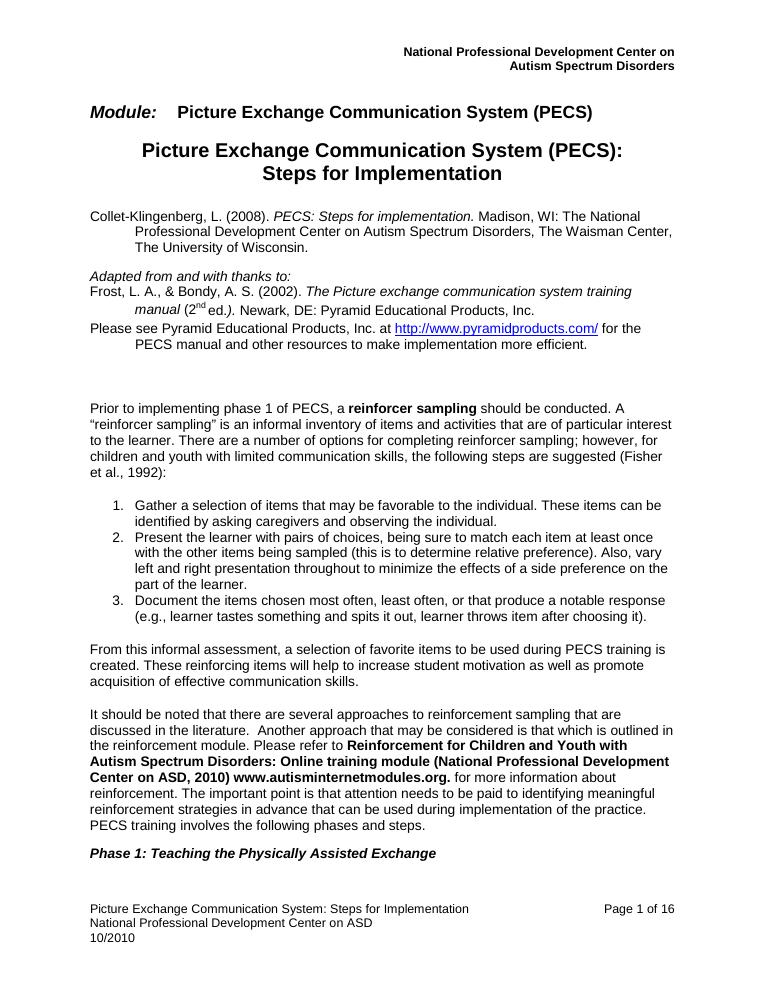
Page 1 of the original 16-page PDF
UNDERSTAND THE RESOURCE
What this implementation guide covers
This is a detailed implementation reference from the National Professional Development Center on Autism Spectrum Disorders. It looks at preparing for PECS, works through six phases and describes how communication can be extended across people and settings.
It gives more procedural detail than the separate six-page AFIRM guide. It is also an older document: it dates from 2008, its footer is dated October 2010, and it should not be read as a new publication or the latest edition. Check current guidance with a trained professional.
At a glance
- Format
- Length
- 16 pages
- Original citation
- 2008
- Document footer
- October 2010
- Focus
- Preparation, six implementation phases and communication across settings
PREPARATION
Preparation starts with the person
Practical groundwork, ideally shared with the person’s support team. It is not a stand-alone treatment protocol.
Discover meaningful interests
The guide begins with finding out what matters to the person: observing preferences, asking people who know them well and noticing how interests change over time.
Prepare people and materials
It introduces communication partners, pictures or symbols and a communication book that the person can reach and use easily.
Plan for everyday situations
Communication opportunities belong across activities, people and settings. The guide’s examples are not a rule that everyone must sit at a table or use the same movements.
THE SIX PHASES
Explore the six phases
An orientation to how the document is organised. People move at different speeds, and nothing here promises speech development.
1
Beginning an exchange
PDF pages 1–4
Understanding the first exchange of a picture with a communication partner.
2
Communicating across distance and settings
PDF pages 4–6
Developing initiation with different partners and in different situations.
3
Choosing between pictures
PDF pages 6–9
Telling pictures apart and checking that a selection matches the intended item.
4
Building a sentence strip
PDF pages 9–11
Combining a request starter with a picture to share a more structured message.
5
Responding to a question
PDF pages 11–12
Responding to “What do you want?” while keeping opportunities for spontaneous requests.
6
Commenting and extending communication
PDF pages 12–15
Moving beyond requests to share observations and communicate for other purposes.
The original includes detailed prompting and error-correction steps for trained practitioners. They are not reproduced here and should not be treated as home instructions.
BEYOND REQUESTING
More than asking for something
PECS is described as supporting several reasons to communicate, not only requests.
Initiating
Starting an interaction.
“A person brings a picture of a swing to a nearby adult.”
Illustrative example, written for this page.
Responding
Answering a communication partner.
“A partner asks what the person wants, and the person answers using pictures.”
Illustrative example, written for this page.
Commenting
Sharing something noticed or experienced.
“On a walk, a person shares that they see a dog.”
Illustrative example, written for this page.
Growing vocabulary. The guide discusses adding descriptive words and attributes, such as colour or size, to make requests and comments more specific. It describes this as possible after Phase 4, so it does not need to wait until all six phases are complete.
EVERYDAY LIFE
Communication across everyday life
Accessible materials, different people and meaningful activities matter. Assistance is adjusted gradually with appropriate professional guidance.
At home
- Keep the communication book where the person can reach it.
- Offer chances to communicate during routines and play.
In learning settings
- Include different partners, such as family, staff and peers.
- Use activities the person finds meaningful.
In the community
- Revisit interests as preferences change.
- Extend vocabulary and chances to communicate over time.
Discuss with your support team
- What does the person want to communicate?
- Where is communication easier?
- Which materials are accessible to them?
- What support helps, and how could it be adjusted over time?
GUIDANCE
Guidance and wider communication options
Use this overview to start informed conversations with professionals.
Official PECS information
This page is an overview of a reference document. It is not formal PECS training, and NeuroReHub does not provide PECS certification or claim affiliation with its developers.
Other communication options
AAC includes many tools and approaches, chosen around individual needs. PECS is not a step that must come before other AAC options.
Respect and comfort
Preferences, comfort and access needs come first. Communication is valued whether or not it involves speech or eye contact, and hands-on prompting is a matter for trained professionals, not casual instruction.
SOURCE AND ACCESS
Read the original document
The PDF is unchanged and opens in a new tab.
Picture Exchange Communication System (PECS): Steps for Implementation
16-page PDF · Approximately 107 KB
Collet-Klingenberg, L. (2008). PECS: Steps for implementation. Madison, WI: The National Professional Development Center on Autism Spectrum Disorders, The Waisman Center, The University of Wisconsin.
The document footer is dated October 2010. It is adapted from Frost and Bondy’s 2002 PECS training manual.
Related resources
NEXT STEP